A clear Google Ads Campaign Structure helps search campaigns stay organized, measurable, and easier to optimize.
Many businesses think Google Ads is only about adding keywords, writing ads, and turning on a budget. But campaign performance depends heavily on structure. If campaigns, ad groups, keywords, ads, landing pages, budgets, and conversion actions are not organized properly, the account becomes difficult to manage.
Google Ads works in layers. At a basic level, an account contains campaigns, campaigns contain ad groups, and ad groups contain related ads and keywords. This structure helps advertisers control budget, targeting, search terms, ad relevance, and performance reporting. Reference: Google Ads account organization guide.
A GA4 reporting workflow for campaign analysis helps review what happens after structured campaigns send traffic to landing pages.
For business growth, campaign structure is not just a setup task. It is the foundation for tracking, testing, optimization, and decision-making.
This blog explains how search campaigns are organized and how a practical campaign structure supports performance marketing.
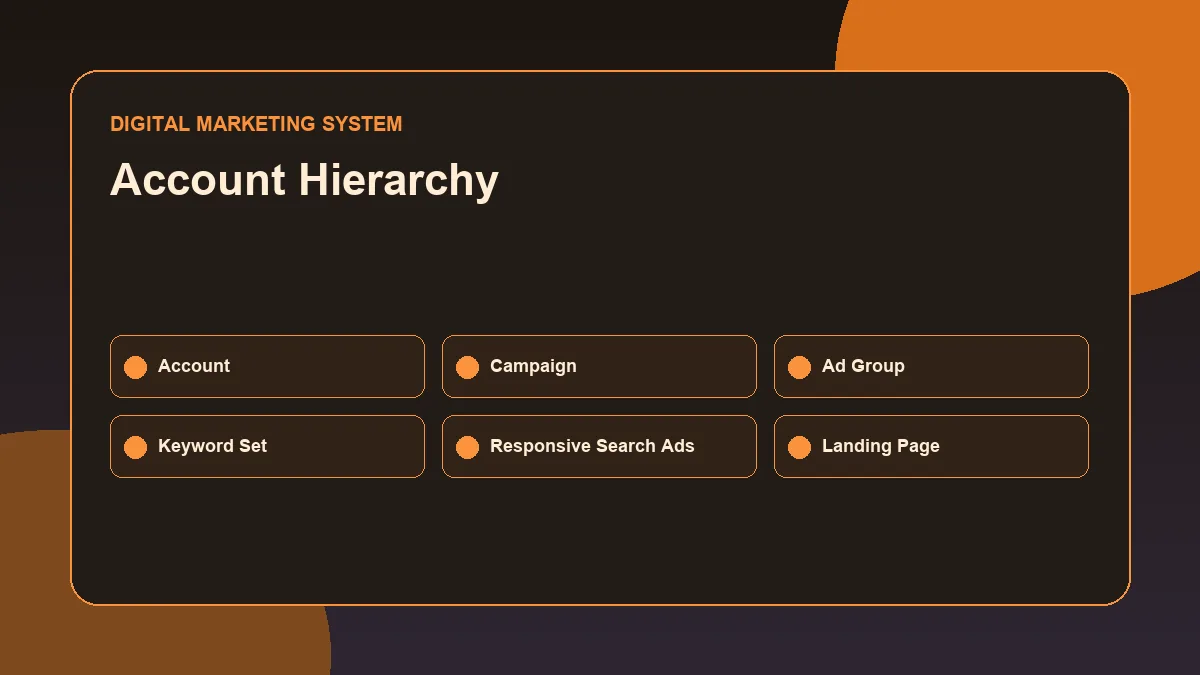
How is a Google Ads search campaign structured? A Google Ads search campaign is structured from account to campaign, ad group, keywords, responsive search ads, landing page and conversion action. The structure should group related search intent together so budgets, ads, landing pages and reporting can be reviewed clearly instead of mixing unrelated services or goals in one place.
What is the difference between a campaign and an ad group?
A campaign controls settings such as budget, bidding, location, language and campaign goal. An ad group sits inside the campaign and groups closely related keywords, ads and landing page intent.
How should keywords be grouped into ad groups?
Keywords should be grouped by similar search intent, service type and landing page relevance. A clearly focused ad group makes ad copy more specific and makes performance review easier.
How do ads, landing pages and conversions connect?
The ad should match the search intent, the landing page should continue the same message, and the conversion action should measure the next valuable step. If one part is disconnected, campaign performance becomes harder to interpret.
- Google Ads Account
- Campaign
- Ad Group
- Keywords
- Responsive Search Ad
- Landing Page
- Conversion
This original visual is provided as readable HTML so users and search systems can understand the full process without relying only on an image.
Simulated example: A local service business could separate emergency service keywords, consultation keywords and brand terms into different ad groups so ad copy and landing pages remain relevant.
Related reading and topical path
This article connects to its hub, guide and related supporting articles.
- /performance-marketing-resource-hub/
- /performance-marketing-guide/
- /landing-page-optimization-for-paid-ads/
- /conversion-tracking-basics/
Written by Deepak Ramachandran
Reviewed/updated: June 16, 2026
Table of Contents
- What Is Google Ads Campaign Structure?
- Why Campaign Structure Matters in Search Ads
- Main Levels of a Google Ads Account
- Account Level
- Campaign Level
- Ad Group Level
- Keyword Level
- Ad Level
- Landing Page Level
- Conversion Tracking Level
- Practical Google Ads Campaign Structure Example
- Common Google Ads Campaign Structure Mistakes
- Final Google Ads Campaign Structure Checklist
- FAQ
What Is Google Ads Campaign Structure?
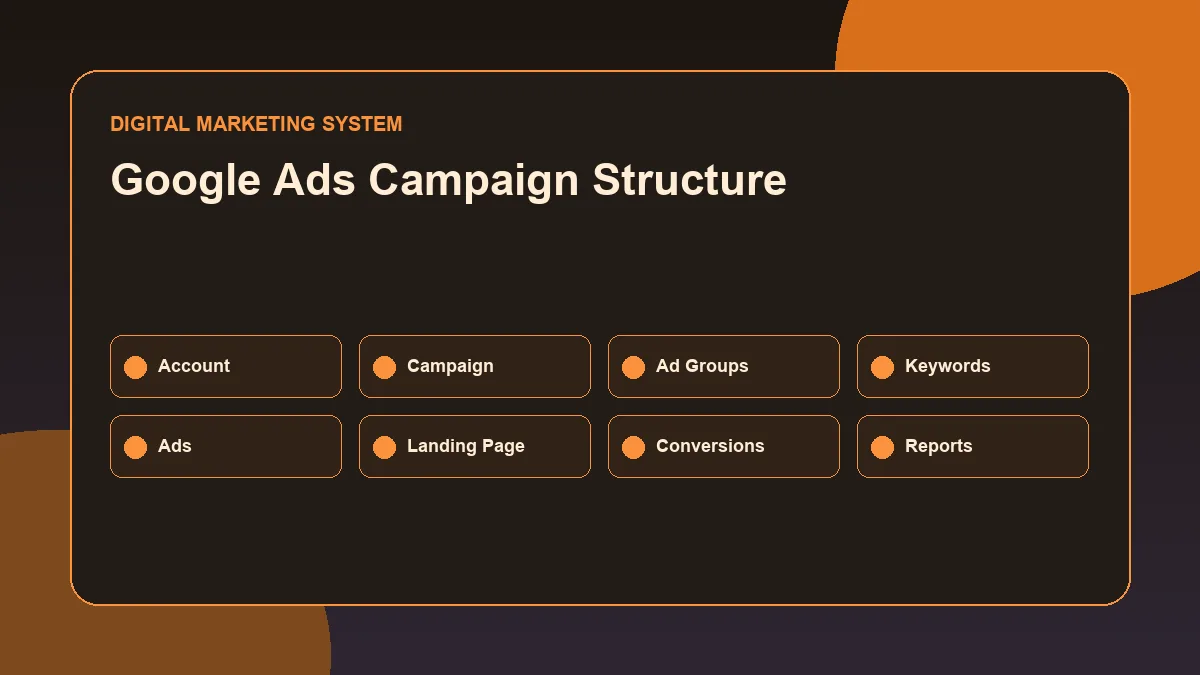
Google Ads Campaign Structure is the way an advertising account is organized into campaigns, ad groups, keywords, ads, landing pages, budgets, and conversion actions.
In a search campaign, structure decides how ads are grouped, which keywords trigger ads, where traffic is sent, how budgets are controlled, and how performance is reviewed.
A basic structure looks like this:
- Google Ads account
- Search campaign
- Ad groups
- Keywords
- Responsive search ads
- Landing pages
- Conversion actions
- Reports and optimization
A good structure makes campaigns easier to understand.
A weak structure creates confusion. It becomes difficult to know which keyword is spending money, which ad group is producing leads, which landing page is converting, and which part of the campaign needs improvement.
Google Ads Campaign Structure is especially important for service businesses, local businesses, ecommerce brands, and lead generation campaigns because every click costs money.
Why Campaign Structure Matters in Search Ads
Search campaigns work best when the campaign is organized around user intent.
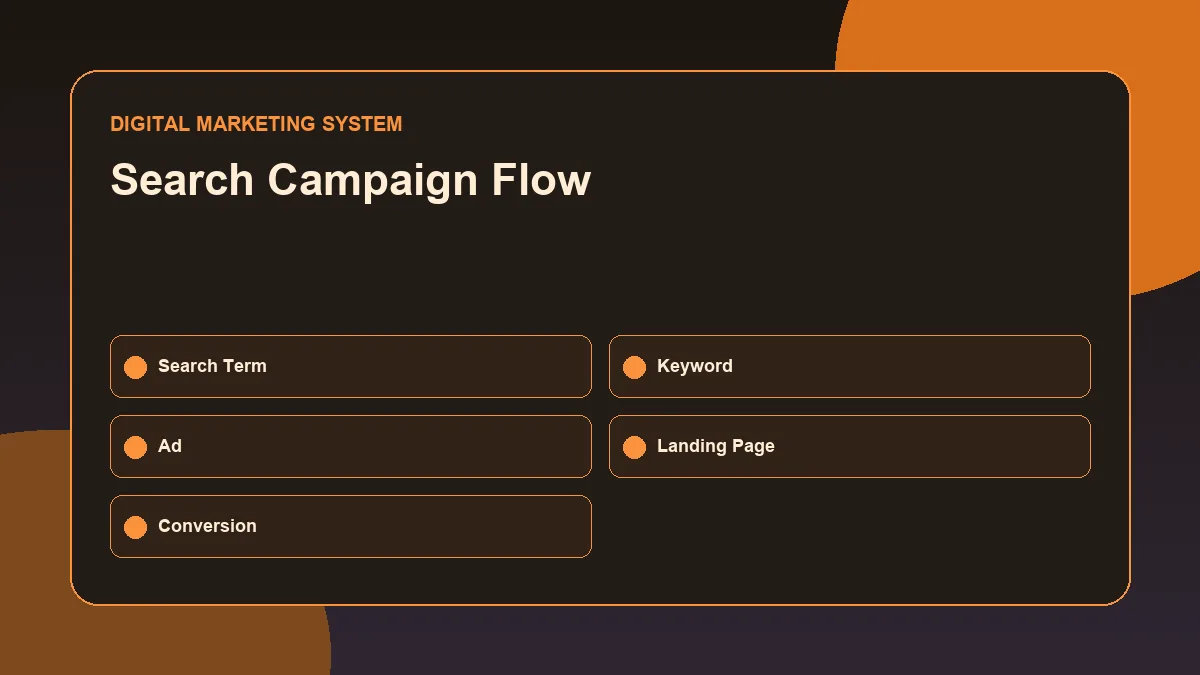
When someone searches on Google, they usually have a problem, need, question, or buying intent. A well-structured campaign connects that search intent with a relevant keyword, ad message, and landing page.
Campaign structure matters because it affects:
- Budget control
- Keyword relevance
- Ad relevance
- Landing page alignment
- Quality Score signals
- Conversion tracking clarity
- Reporting accuracy
- Optimization decisions
- Lead quality
- Cost efficiency
A campaign with poor structure may still get clicks, but those clicks may not become useful business actions.
For example, if one ad group contains too many unrelated keywords, the ad copy becomes generic. If the ad copy is generic, the user may not feel that the ad matches the search. If the landing page is also generic, the conversion rate may drop.
A strong structure keeps each part connected: search query, keyword, ad group, ad copy, landing page, and conversion action.
That connection is the practical foundation of performance marketing. It also connects with the wider ideas explained in the Performance Marketing Resource Hub and the Performance Marketing for Business Growth foundation article.
Main Levels of a Google Ads Account
Google Ads is organized into three main layers:
- Account
- Campaigns
- Ad groups
Google official documentation explains that campaigns have their own budget and settings, while ad groups contain sets of similar ads and keywords.
For search campaigns, this structure is important because different decisions happen at different levels.
The account level controls overall access and billing.
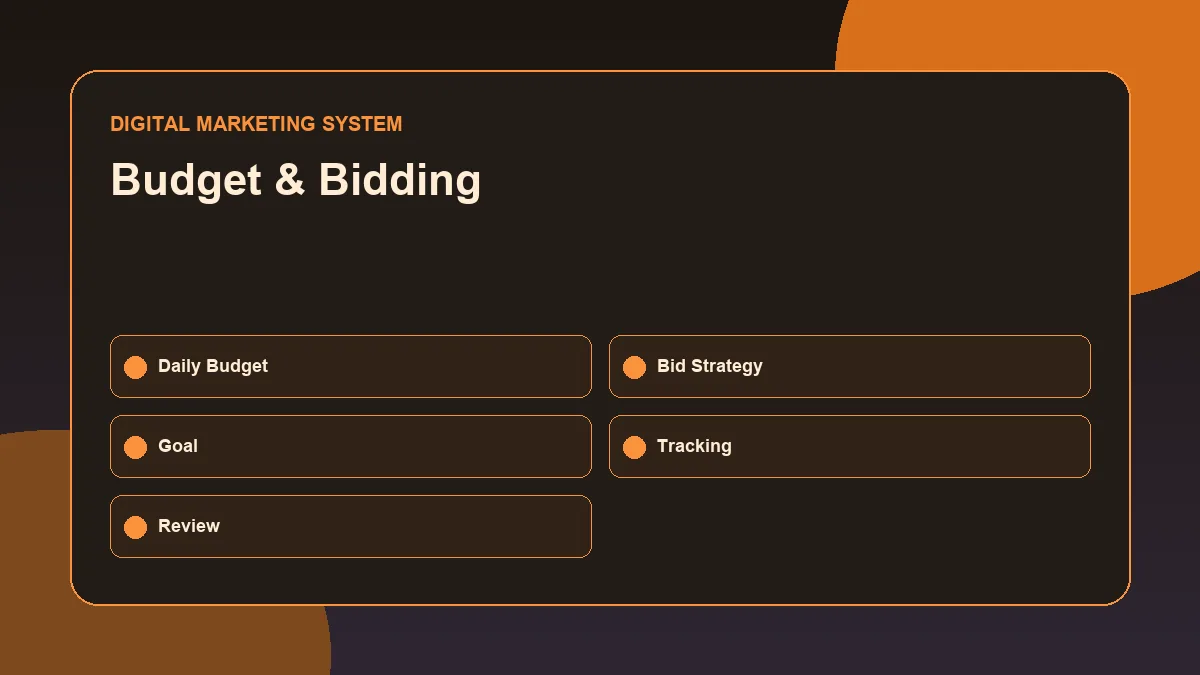
The campaign level controls budget, bidding, location, language, network, and campaign goal.
The ad group level controls keyword themes, ads, and keyword-level organization.
When each level has a clear role, campaign management becomes easier.
Account Level
The account level is the top layer of Google Ads.
It usually includes:
- Business account access
- Billing details
- Account settings
- Linked tools
- Conversion tracking setup
- Manager access if applicable
- Account-wide negative keywords where needed
- Brand safety and policy settings
For a small business, the account level may contain only a few campaigns.
For a larger business, the account may contain multiple campaigns for different services, products, locations, or funnel stages.
At this level, the goal is not to create everything randomly. The account should be organized in a way that matches the business model.
Example account structure:
- Brand search campaign
- Non-brand service campaign
- Location-based campaign
- Remarketing campaign
- Competitor campaign if appropriate
- Seasonal offer campaign
Not every business needs all of these. The structure should match the goal, budget, and search demand.
Campaign Level
The campaign level is where major settings are controlled.
In Google Ads, each campaign has its own budget and settings that affect where ads appear.
Important campaign-level settings include:
- Campaign objective
- Campaign type
- Daily budget
- Bidding strategy
- Location targeting
- Language targeting
- Ad schedule
- Network settings
- Conversion goals
- Audience signals or observation settings
- Campaign-level negative keywords
- Start and end dates where needed
For search campaigns, the campaign level should usually separate major business goals or service categories.
Example:
- Campaign 1: SEO Services Search Campaign
- Campaign 2: Website Design Search Campaign
- Campaign 3: Google Ads Services Search Campaign
- Campaign 4: Brand Search Campaign
This separation helps budget control.
If all services are placed inside one campaign, it becomes harder to control spending between different business priorities.
For example, SEO service keywords and website design keywords may have different cost, intent, competition, and conversion quality. Keeping them in separate campaigns can make reporting and optimization clearer.
Ad Group Level
Ad groups sit inside campaigns.
An ad group contains similar ads and keywords. Google recommends creating ad groups around narrow themes and using keywords related to that theme.
The ad group level is where keyword themes become important.
A good ad group should focus on one specific intent or topic.
Example campaign: SEO Services Search Campaign.
Possible ad groups:
- SEO services
- Local SEO services
- WordPress SEO services
- SEO audit services
- Ecommerce SEO services
Each ad group should contain keywords related to that exact theme.
For example, an SEO audit services ad group may include:
- seo audit service
- website seo audit
- technical seo audit
- seo audit for website
- seo audit consultant
The ads inside this ad group should mention SEO audits clearly. The landing page should also match the SEO audit intent.
This creates a stronger connection between keyword, ad, and landing page.
Keyword Level
Keywords decide which searches may trigger ads.
When creating search campaign ad groups, Google Ads allows advertisers to add keywords and choose match types to control which searches can trigger ads.
Common keyword match types include:
- Broad match
- Phrase match
- Exact match
Each match type has a different level of control.
Broad match can reach a wider set of related searches.
Phrase match gives more control while still allowing close variations.
Exact match gives tighter control around specific search meaning.
For new or small-budget campaigns, keyword control is important because irrelevant clicks can waste money quickly.
A practical keyword structure should consider:
- Search intent
- Match type
- Cost per click
- Competition
- Conversion relevance
- Landing page match
- Negative keywords
- Search term review
Keyword selection should not be based only on volume. A lower-volume keyword with strong intent may be more valuable than a high-volume keyword with weak intent.
Example:
- digital marketing may be broad and unclear
- google ads agency for local business has stronger commercial intent
- seo audit service for website has clearer service intent
Search campaigns become stronger when keywords are grouped by intent, not only by topic.
Ad Level
Ads are the messages users see in search results.
In search campaigns, ad copy should match the keyword theme and landing page.
A strong search ad usually includes:
- Clear headline
- Relevant keyword theme
- Main benefit
- Trust signal
- Service or offer clarity
- Location if relevant
- Strong call to action
- Landing page alignment
The ad should not feel disconnected from the search.
Example: if the ad group is about SEO audit services, the ad should not only say Best Digital Marketing Services. It should speak directly about SEO audits, website analysis, technical issues, and improvement opportunities.
A better ad message may focus on:
- Website SEO audit
- Technical and content review
- Search visibility improvement
- Clear action plan
- Contact or enquiry CTA
Strong ad relevance improves user trust before the click.
Landing Page Level
The landing page is where campaign traffic becomes business action.
A good Google Ads Campaign Structure does not stop inside the ad account. It must connect to the landing page.
A landing page should match the campaign intent.
For example, if the keyword is SEO audit service, the landing page should focus on SEO audit service.
It should not send users to a generic homepage unless the homepage is highly relevant.
A strong landing page should include:
- Clear headline
- Service explanation
- Problem-solution section
- Benefits
- Trust signals
- Process
- FAQ
- Strong CTA
- Simple contact form
- Fast loading speed
- Mobile-friendly design
Landing page mismatch is a common reason paid campaigns underperform.
If users click an ad and land on a page that does not answer their intent, they may leave without taking action.
From a performance marketing perspective, campaign structure and landing page structure should work together.
Conversion Tracking Level
Conversion tracking measures valuable user actions.
A campaign cannot be properly optimized if conversions are not tracked.
Important conversion actions may include:
- Form submissions
- Phone calls
- WhatsApp clicks
- Purchases
- Bookings
- Sign-ups
- Lead form submissions
- Newsletter sign-ups
- Key page visits
- Button clicks
For lead generation campaigns, tracking should focus on actions that show real business interest.
Clicks alone are not enough.
A campaign may get many clicks, but if users do not call, submit a form, or take another useful action, the campaign may not support business growth.
Conversion tracking helps answer:
- Which campaign produced leads?
- Which ad group converted?
- Which keywords created useful actions?
- Which landing page performed better?
- Which budget decision should be made next?
Without tracking, optimization becomes guesswork.
Practical Google Ads Campaign Structure Example
Here is a simple example for a local service business offering digital marketing services.
Campaign: Google Ads Services Search Campaign.
Campaign settings:
- Objective: Lead generation
- Network: Search
- Location: Thrissur or Kerala, depending on service area
- Budget: Controlled daily budget
- Bidding: Based on account maturity and conversion data
- Conversion action: Contact form submission or phone click
Ad Group 1: Google Ads Services.
Keywords:
- google ads services
- google ads expert
- google ads consultant
- google ads management
Landing page: Google Ads service page.
Ad Group 2: PPC Services.
Keywords:
- ppc services
- ppc campaign management
- ppc advertising service
- paid search marketing
Landing page: PPC or performance marketing service page.
Ad Group 3: Local Business Ads.
Keywords:
- google ads for local business
- local business advertising
- search ads for local services
Landing page: Local business campaign landing page.
This structure is simple, but it is easier to optimize than placing all keywords in one ad group.
Each ad group has a theme. Each theme has related keywords. Each keyword group can have relevant ad copy. Each ad can point to a matching landing page.
That is the basic logic of strong search campaign organization.
Common Google Ads Campaign Structure Mistakes
Many businesses lose budget because campaigns are not structured properly.
Common mistakes include:
- Putting too many services into one campaign
- Using one ad group for all keywords
- Mixing unrelated keyword intents
- Sending all traffic to the homepage
- Not using negative keywords
- Ignoring conversion tracking
- Using broad match without monitoring search terms
- Writing generic ad copy
- Not separating brand and non-brand campaigns
- Not separating locations when needed
- Not reviewing landing page quality
- Not checking mobile experience
- Making changes without enough data
- Tracking only clicks instead of conversions
- Optimizing for traffic instead of lead quality
One of the biggest mistakes is thinking that Google Ads success depends only on budget.
Budget matters, but structure controls how the budget is used.
A small campaign with clear structure can often teach more than a larger campaign with poor organization.
Final Google Ads Campaign Structure Checklist
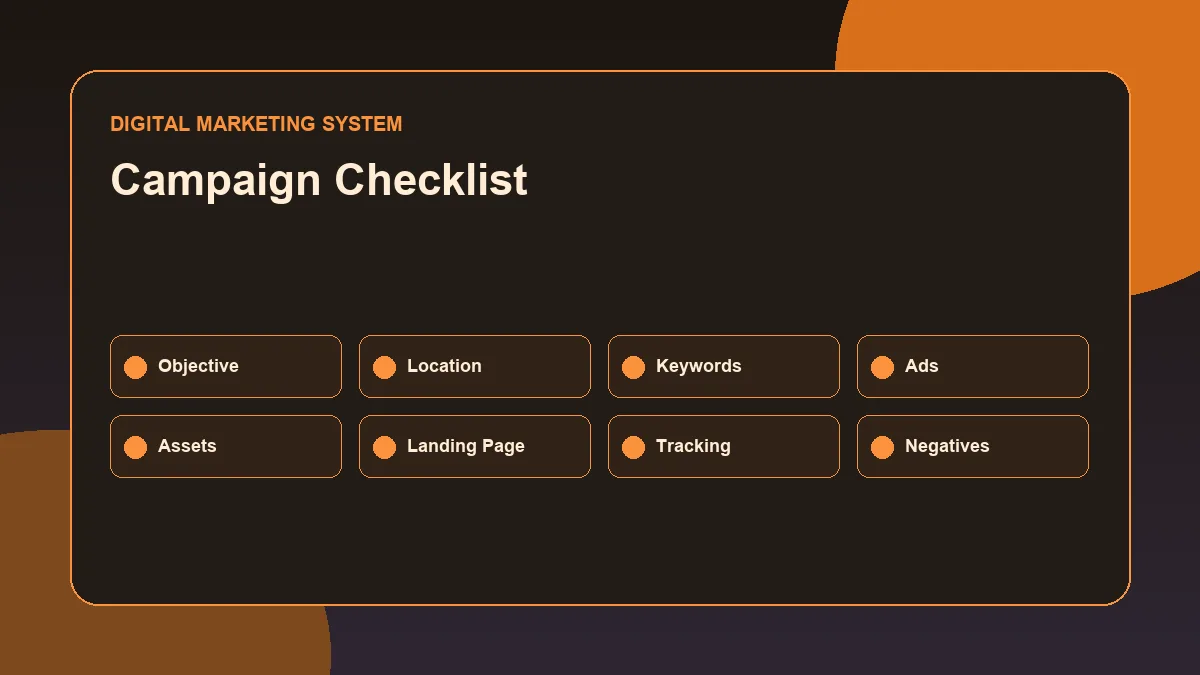
Use this checklist before launching or reviewing a search campaign.
- Campaign objective is clear
- Campaign type is selected correctly
- Budget is set at campaign level
- Location targeting is accurate
- Language targeting is correct
- Search network settings are reviewed
- Conversion action is selected
- Ad groups are organized by narrow themes
- Keywords match each ad group theme
- Match types are selected carefully
- Negative keywords are added where needed
- Ads match keyword intent
- Landing pages match ad group intent
- CTA is clear on landing page
- Conversion tracking is tested
- Search terms are reviewed regularly
- Reports are checked at campaign, ad group, keyword, and ad level
- Poor-performing terms are optimized
- Campaign changes are documented
- Decisions are based on conversion quality, not only clicks
A good Google Ads Campaign Structure is not created once and forgotten.
It should be reviewed regularly.
Search terms may reveal irrelevant traffic. Some keywords may spend without converting. Some ads may have weak click-through rates. Some landing pages may need stronger CTAs.
The goal is not just to run ads. The goal is to build a campaign system that can be measured, improved, and connected to business growth.
Want to Understand Paid Ads, Tracking, and Optimization?
Explore the Performance Marketing Resource Hub for practical guides on Google Ads, conversion tracking, CRO, analytics, and campaign planning.
You can also visit the Performance Marketing Guide to understand how performance marketing connects strategy, traffic, tracking, and business outcomes.
For website optimization, campaign structure, or digital marketing collaboration discussions, visit the Contact page.
FAQ
What is Google Ads Campaign Structure?
Google Ads Campaign Structure is the way an account is organized into campaigns, ad groups, keywords, ads, landing pages, budgets, and conversion actions. It helps advertisers manage targeting, budget, reporting, and optimization.
Why is campaign structure important in Google Ads?
Campaign structure is important because it affects budget control, keyword relevance, ad quality, landing page alignment, tracking clarity, and optimization decisions. Poor structure can waste budget and make reporting confusing.
What is the difference between a campaign and an ad group?
A campaign controls major settings such as budget, bidding, location, language, and campaign objective. An ad group sits inside a campaign and contains related ads and keywords around a narrow theme.
How many ad groups should a search campaign have?
There is no fixed number for every business. A search campaign should have enough ad groups to separate important keyword themes clearly. Each ad group should focus on a narrow topic or intent.
Should all keywords be placed in one ad group?
No. Placing all keywords in one ad group usually makes ads less relevant. Keywords should be grouped by theme, intent, service type, or landing page relevance.
Does Google Ads Campaign Structure affect conversions?
Yes. Campaign structure can affect conversions because it controls how closely the keyword, ad copy, landing page, and conversion action match the user search intent.
A Google Ads campaign plan for a local service business applies campaign, ad group, keyword, ad and landing-page structure to a simulated lead-generation example.