Marketing becomes stronger when it can be measured, improved, and connected to business goals. That is the main reason Performance Marketing for Business Growth matters.
Performance marketing is not just about running ads on Google, Meta, or any other platform. It is a structured approach where strategy, tracking, landing pages, campaign setup, reporting, and optimization work together to improve business outcomes.
A deeper GA4 reporting workflow helps connect traffic sources, landing pages, key events and optimization decisions after campaigns are running.
A business can spend money on ads and still fail if the strategy is weak, tracking is missing, or the landing page does not convert. At the same time, even a small campaign can become useful when every part of the system is planned properly.
This is why the Performance Marketing Resource Hub on this website focuses on practical campaign thinking, measurable growth, analytics, CRO, and optimization workflows instead of treating paid marketing as random ad boosting.
What is performance marketing for business growth? Performance marketing for business growth is a measurable marketing approach where campaigns, landing pages, audiences, conversion tracking and reporting are planned around specific business actions. It does not mean spending more on ads blindly; it means connecting objectives, channels, data and optimization so decisions are based on evidence rather than assumptions.
How is performance marketing different from general digital marketing?
Performance marketing is more measurement-led than general digital marketing because it focuses on defined actions such as enquiries, purchases, calls, sign-ups or qualified leads. General digital marketing may include awareness and communication work, while performance marketing needs tracking, testing and optimization loops.
Which metrics are used in performance marketing?
Common performance marketing metrics include impressions, clicks, CTR, CPC, conversion rate, cost per lead, CPA, ROAS and lead quality indicators. The right metric depends on the business objective, channel and whether tracking is ready enough to measure the action accurately.
Why are tracking and landing pages important?
Tracking and landing pages are important because ads alone cannot prove business value. Tracking shows which actions happened, while landing pages decide whether visitors understand the offer, trust the message and complete the next step.
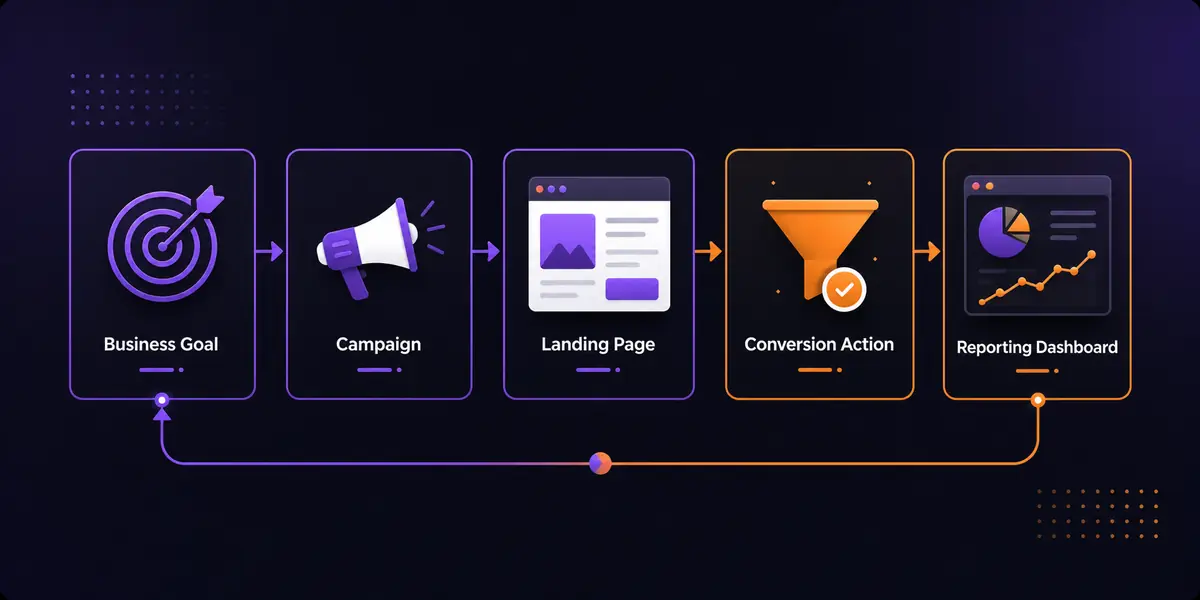
- Business Objective
- Campaign
- Audience
- Landing Page
- Conversion
- Reporting
- Optimization
This original visual is provided as readable HTML so users and search systems can understand the full process without relying only on an image.
Disclosure: This is a simulated strategy example created for portfolio and educational demonstration purposes.
Related reading and topical path
This article connects to its hub, guide and related supporting articles.
- /performance-marketing-resource-hub/
- /performance-marketing-guide/
- /conversion-tracking-basics/
- /landing-page-optimization-for-paid-ads/
Written by Deepak Ramachandran
Reviewed/updated: June 16, 2026
Table of Contents
What Is Performance Marketing for Business Growth?
Performance marketing is a digital marketing approach where campaigns are planned, measured, and optimized based on specific actions.
These actions may include:
- Leads
- Sales
- Calls
- Form submissions
- WhatsApp clicks
- App installs
- Bookings
- Sign-ups
- Purchases
- Enquiries
For business growth, performance marketing focuses on outcomes instead of vanity metrics. Impressions, likes, and reach may be useful in some contexts, but they are not enough by themselves. A business needs to understand whether marketing activity is creating real interest, qualified traffic, leads, or revenue opportunities.
Performance Marketing for Business Growth connects three major questions:
- What is the business trying to achieve?
- How will the campaign measure success?
- What changes can improve the result?
This is what makes performance marketing different from general digital promotion. It is not only about visibility. It is about measurable progress.
Why Performance Marketing Matters for Modern Businesses
Businesses need marketing systems that can be reviewed and improved. Without measurement, marketing decisions become guesswork.
Performance marketing matters because it gives businesses a clearer way to understand where money is going, what users are doing, and which parts of the funnel need improvement.
It connects marketing spend with measurable outcomes
A business may spend money on ads, content, creatives, or campaigns. But the real question is: what did that spend produce?
Performance marketing connects spend with outcomes such as:
- Cost per lead
- Cost per purchase
- Conversion rate
- Return on ad spend
- Lead quality
- Landing page performance
- Campaign-level results
This helps businesses avoid one of the biggest digital marketing problems: spending money without understanding performance.
It helps businesses understand what works
Performance marketing creates feedback. For example, a Google Ads campaign may show which keywords bring clicks. A Meta Ads campaign may show which audience responds better. A landing page may show whether users are completing forms or dropping off.
When this data is reviewed properly, it becomes easier to identify what is working and what needs to change. A campaign should not be judged only by whether it is running. It should be judged by whether it is moving users toward the business goal.
It improves decision-making over time
Performance marketing becomes more useful when decisions are based on data, not assumptions. A business may learn that:
- One campaign gets cheaper leads
- One audience has better conversion quality
- One landing page has a stronger form submission rate
- One keyword spends budget but does not convert
- One ad creative gets clicks but poor enquiries
These insights help improve future campaigns. Over time, performance marketing becomes a learning system for business growth.
The Three Core Parts of Performance Marketing
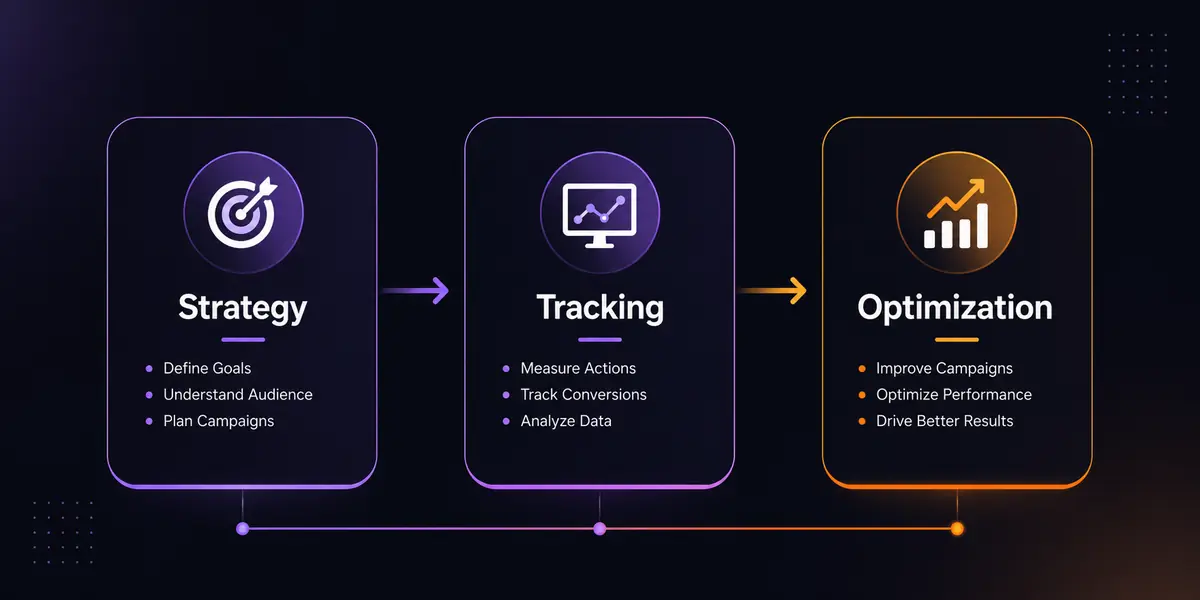
Performance marketing works best when three parts are connected: strategy, tracking, and optimization. The Performance Marketing Guide supports this foundation by explaining the wider campaign system in more detail.
If one part is weak, the full system becomes weaker.
Strategy
Strategy defines the direction of the campaign.
Before launching ads, a business should be clear about:
- Campaign objective
- Target audience
- Offer or service
- Budget
- Funnel stage
- Platform selection
- Landing page requirement
- Conversion action
- Success metric
For example, a lead generation campaign and a brand awareness campaign should not be planned in the same way. Their goals, targeting, ad copy, landing pages, and metrics will be different.
Strategy prevents random execution. It makes sure the campaign is built for a specific business outcome.
Tracking
Tracking measures what users do after they interact with a campaign. The Google Ads conversion measurement guide explains how conversion actions and conversion data help measure campaign performance.
Without tracking, a business may know how many people clicked an ad, but not how many completed a valuable action.
Tracking may include:
- Google Ads conversion tracking
- Meta Pixel events
- GA4 events
- Form submission tracking
- Button click tracking
- Phone call tracking
- WhatsApp click tracking
- UTM tracking
- Thank-you page tracking
Tracking helps answer an important question: did the campaign create meaningful action? If tracking is missing or incorrect, campaign decisions become unreliable.
Optimization
Optimization means improving campaigns based on performance data. This can include:
- Pausing weak keywords
- Improving ad copy
- Testing new creatives
- Adjusting audiences
- Reviewing search terms
- Improving landing page sections
- Reducing irrelevant clicks
- Fixing tracking issues
- Changing bidding strategy
- Improving call-to-action placement
Optimization is not a one-time activity. It is an ongoing process of review, learning, and improvement.
How Strategy, Tracking, and Optimization Work Together
Strategy, tracking, and optimization should not be treated as separate tasks.
A campaign starts with strategy. Tracking measures whether the strategy is working. Optimization improves the campaign based on what tracking reveals.
A simple way to understand this is:
- Strategy decides the goal.
- Tracking measures the action.
- Optimization improves the result.
For example, if a local service business wants leads, the campaign strategy may focus on search ads targeting high-intent keywords. The tracking setup may measure form submissions and phone clicks. The optimization process may review which keywords, ads, and landing page sections are producing qualified enquiries.
This is the foundation of Performance Marketing for Business Growth. It turns marketing from random promotion into a measurable growth system.
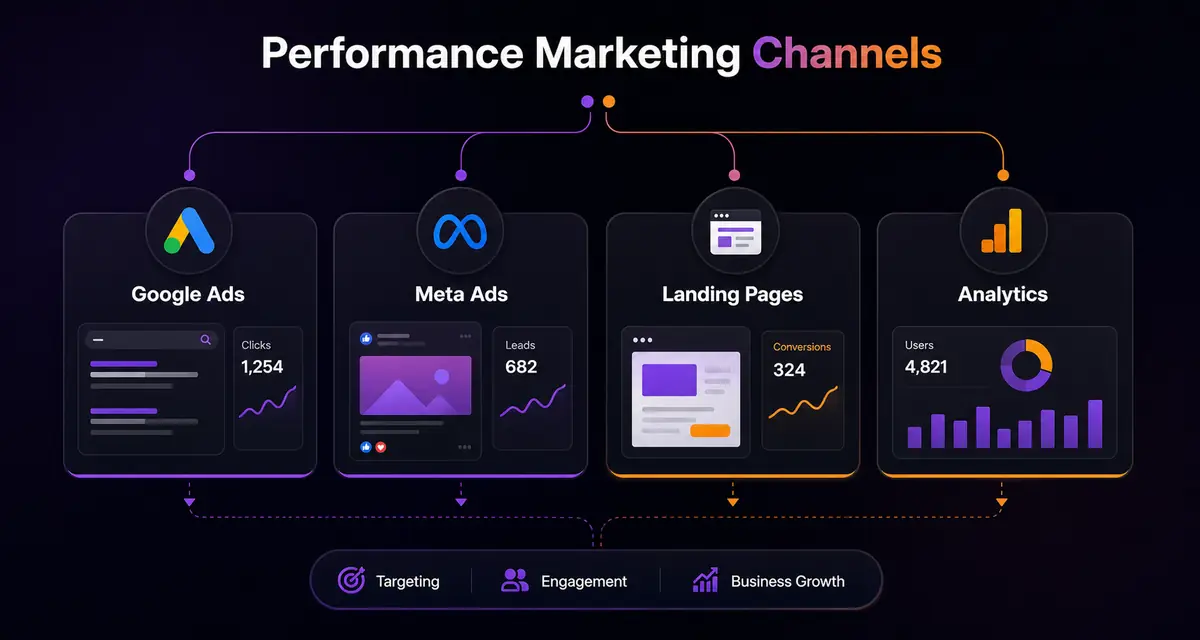
Key Channels Used in Performance Marketing
Performance marketing can include different channels depending on the business goal, audience, budget, and funnel stage.
Google Ads
Google Ads is useful when users are already searching for something. For example, a person searching for “digital marketing services near me” or “website SEO audit” may already have strong intent. Search campaigns can target these users based on keywords.
Google Ads is often useful for:
- Lead generation
- Local services
- Search intent campaigns
- High-intent keywords
- Remarketing
- Shopping campaigns
- App campaigns
But Google Ads needs proper structure. Campaigns, ad groups, keywords, match types, extensions, landing pages, and conversions must be planned carefully. A Google Ads campaign structure guide can help organize this setup.
Meta Ads
Meta Ads can be useful for demand generation, remarketing, audience targeting, and visual offer promotion. Unlike Google Search Ads, Meta users are usually not searching actively. They are scrolling through Facebook or Instagram. So the ad creative, hook, offer, and audience selection become very important.
Meta Ads may support:
- Brand awareness
- Lead generation
- Retargeting
- Offer promotion
- Content distribution
- Funnel building
- Local business visibility
A strong Meta campaign needs good creative testing, audience logic, and landing page alignment.
Landing pages
A landing page is where campaign traffic becomes business action. Even if ads are well structured, a weak landing page can reduce performance.
A good landing page should include:
- Clear headline
- Relevant offer
- Trust signals
- Strong call to action
- Fast loading speed
- Mobile-friendly design
- Simple form
- Clear benefits
- Problem-solution explanation
- Reduced distractions
Landing page optimization is important because campaign performance does not depend only on the ad platform. It also depends on what users experience after the click. A focused landing page optimization workflow can help improve this part of the funnel.
Analytics and reporting tools
Analytics tools help understand what happens across campaigns, traffic sources, landing pages, and user actions.
Tools like GA4 can help review:
- Traffic sources
- Landing page performance
- Events
- Conversions
- User engagement
- Campaign performance
- Funnel behavior
Reporting is not only about creating dashboards. It is about understanding what the data means and what decision should come next. A practical GA4 reporting workflow helps connect data with decisions.
Core Metrics in Performance Marketing
Performance marketing uses metrics to understand campaign quality and business impact.
Important metrics include:
- CTR: Percentage of users who click after seeing an ad
- CPC: Average cost for each click
- CPM: Cost per thousand impressions
- CPA: Cost per acquisition or lead
- ROAS: Revenue generated for every rupee spent on ads
- Conversion rate: Percentage of visitors who complete the desired action
- Landing page views: Number of users who reach the page after clicking
- Lead quality: Relevance and potential value of enquiries
- Impression share: Visibility compared to available search demand
- Bounce or engagement signals: User interaction quality on the landing page
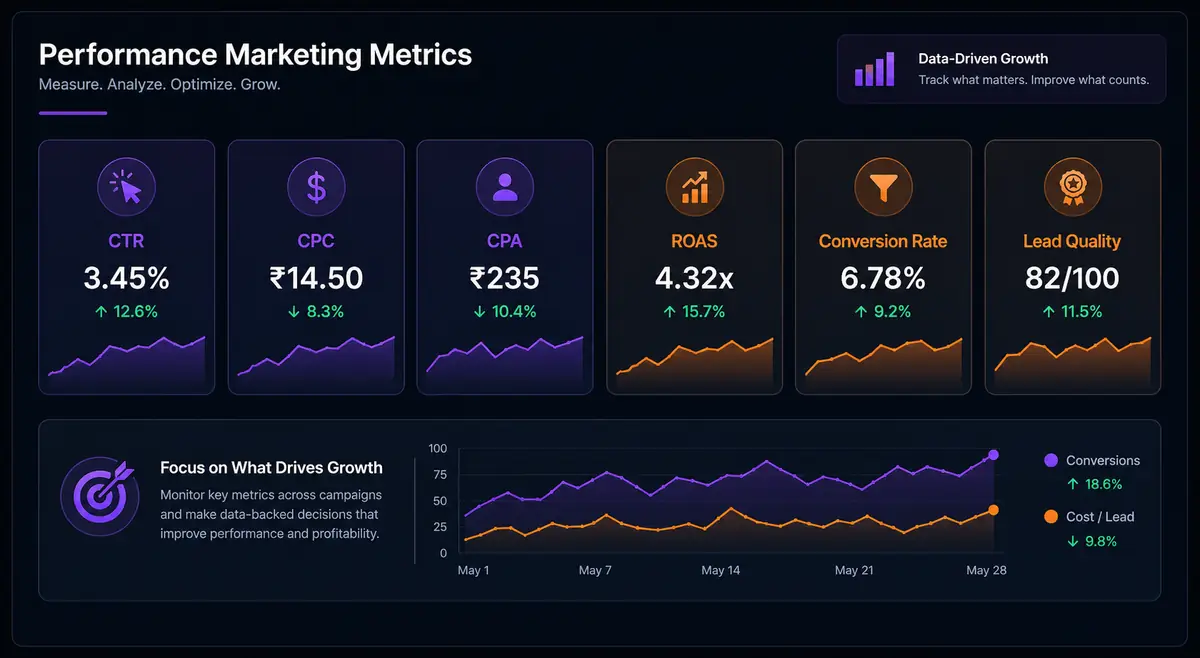
Metrics should not be reviewed in isolation. For example, a campaign may have a low CPC but poor lead quality. Another campaign may have a higher CPC but stronger enquiries. From a business growth perspective, the second campaign may be more valuable.
This is why performance marketing requires both data analysis and business thinking.
Practical Performance Marketing Workflow for Business Growth
A practical workflow can make performance marketing easier to manage. Here is a simple structure:
- Define the business goal
- Choose the campaign objective
- Identify the target audience
- Select the right platform
- Plan the offer and message
- Build or improve the landing page
- Set up conversion tracking basics
- Add UTM parameters where needed
- Launch the campaign with a controlled budget
- Monitor early performance
- Review conversion data
- Check lead quality
- Optimize keywords, audiences, creatives, and landing page sections
- Prepare a simple performance report
- Use insights for the next campaign cycle
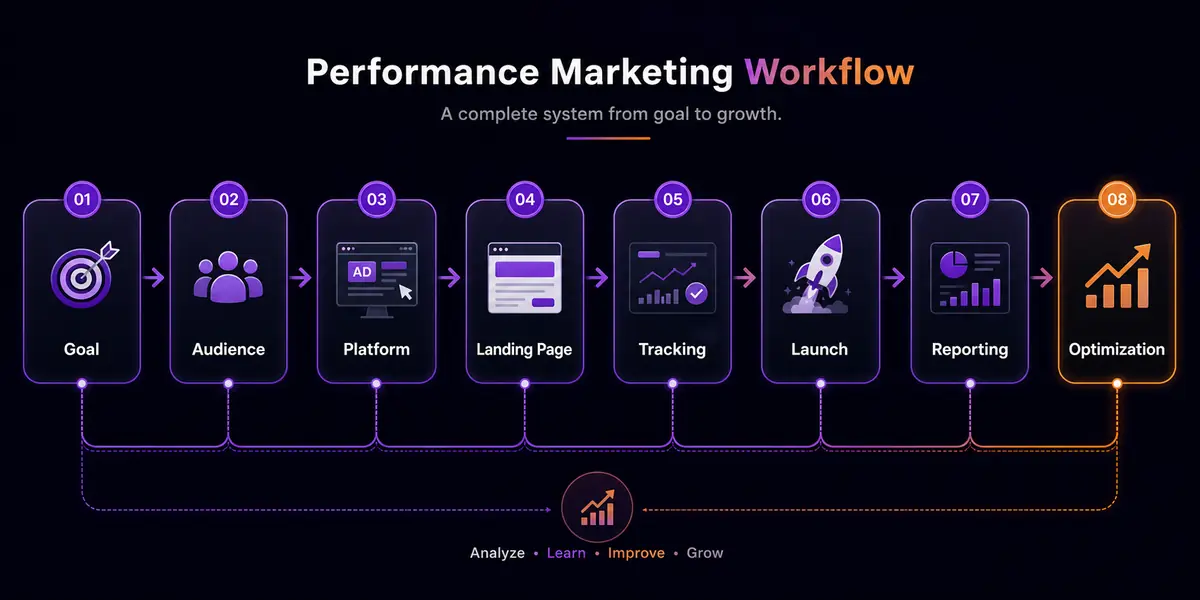
This workflow keeps performance marketing practical. It avoids the mistake of launching ads without a measurement system.
For a business website, the goal is not just to increase traffic. The goal is to connect traffic with useful actions.
Common Performance Marketing Mistakes Businesses Make
Many campaigns fail because the foundation is weak.
- Running ads without a clear objective
- Boosting posts without funnel thinking
- Sending paid traffic to weak landing pages
- Not setting up conversion tracking
- Tracking clicks but not leads
- Ignoring lead quality
- Using broad audiences without testing
- Changing campaigns too quickly
- Judging campaigns only by likes or reach
- Not using UTM parameters
- Not reviewing search terms
- Ignoring mobile page speed
- Not separating awareness, consideration, and conversion campaigns
- Making decisions without enough data
One of the biggest mistakes is thinking that performance marketing means only paid ads. Ads are only one part of the system. The real performance comes from the connection between audience, message, landing page, tracking, reporting, and optimization.
Example: Performance Marketing for a Local Service Business
Consider a local service business that wants more enquiries.
A simple performance marketing structure could look like this:
- Campaign goal: Generate qualified leads
- Platform: Google Ads search campaign
- Audience intent: Users searching for the service
- Landing page: Service-specific page with clear CTA
- Conversion action: Form submission or phone call
- Tracking: Google Ads conversion tracking and GA4 events
- Optimization: Review keywords, search terms, cost per lead, and lead quality
In this example, the campaign is not just running ads. It is a structured system.
If clicks are high but leads are low, the landing page may need improvement. If leads are coming but quality is poor, the keywords or targeting may need review. If conversions are not showing, tracking may need to be fixed.
This is how performance marketing supports business growth. It helps identify where the system is strong and where it needs improvement.
Why Performance Marketing Is Not Just Running Ads
Performance marketing is often misunderstood as simply launching Google Ads or Meta Ads. In reality, paid ads are only the traffic source.
Performance marketing also includes:
- Business objective planning
- Funnel strategy
- Audience research
- Offer positioning
- Campaign structure
- Conversion tracking
- Landing page optimization
- Reporting
- CRO
- Budget decisions
- Continuous optimization
A campaign without tracking is incomplete. A campaign without a strong landing page is limited. A campaign without reporting cannot teach the business what to improve.
Performance Marketing for Business Growth works best when every part of the system supports a clear outcome.
A practical Google Ads campaign plan shows how business goals, keywords, landing pages, conversion tracking and reporting can be connected before launch.
Conclusion
Performance Marketing for Business Growth is not about spending more money on ads. It is about using strategy, tracking, and optimization to make marketing more measurable and useful.
A strong performance marketing system starts with a clear business goal. It then connects campaign planning, audience targeting, landing page experience, conversion tracking, reporting, and continuous improvement.
For businesses, this approach creates better decision-making. Instead of guessing what works, performance marketing helps identify which campaigns, channels, messages, and pages are moving users toward meaningful actions.
The real value is not only traffic. It is measurable growth, stronger conversion paths, better use of budget, and a clearer understanding of how digital marketing supports business outcomes.
Continue Reading
FAQ Section
What is Performance Marketing for Business Growth?
Performance Marketing for Business Growth is a measurable marketing approach where campaigns are planned, tracked, and optimized to support business outcomes such as leads, sales, enquiries, bookings, or sign-ups.
Is performance marketing only paid ads?
No. Paid ads are one part of performance marketing. A complete performance marketing system also includes strategy, tracking, landing pages, analytics, reporting, CRO, funnel planning, and optimization.
Why is conversion tracking important in performance marketing?
Conversion tracking is important because it shows whether users are completing valuable actions after interacting with campaigns. Without tracking, it is difficult to know which campaigns are producing real business results.
Which platforms are used in performance marketing?
Common platforms include Google Ads, Meta Ads, LinkedIn Ads, YouTube Ads, and analytics tools like GA4. The right platform depends on the business goal, audience, budget, and funnel stage.
What metrics matter most in performance marketing?
Important metrics include CTR, CPC, CPA, ROAS, conversion rate, landing page performance, lead quality, and revenue impact. The most important metric depends on the campaign objective.
How does performance marketing support small businesses?
Performance marketing helps small businesses spend more carefully, track useful actions, improve campaigns over time, and understand which marketing activities are producing enquiries or sales opportunities.
Want to understand how paid ads, tracking, landing pages, and optimization work together?
Explore the Performance Marketing Resource Hub for practical guides on campaign structure, conversion tracking, GA4 reporting, landing page optimization, and CRO.
For collaboration, website optimization, or performance marketing discussions, visit the Contact page.