A business website is not useful only because it exists online. It becomes useful when the right people can find it, understand it, trust it, and take action. That is where SEO for Business Websites becomes important.
Search engine optimization helps a website become more visible for the searches that matter to a business. It is not just about ranking for random keywords or adding more blog posts. In a real business website, SEO connects search intent, content structure, technical performance, user experience, and conversion goals.
For a professional digital marketing portfolio, SEO also works as a proof system. It shows how a website is planned, structured, optimized, and connected through content. This is why the SEO Resource Hub on this website is designed to organize SEO topics in a practical way instead of publishing disconnected articles.
What is SEO for a business website? SEO for a business website is the structured process of helping search engines understand important pages while helping users find clear answers, services and next steps. It connects keyword research, on-page SEO, technical SEO, internal linking and Search Console review so a business website can build relevant visibility over time without shortcuts or ranking promises.
Why is SEO important for a business website?
SEO is important because a business website needs to be discoverable when people search for problems, services or comparisons related to that business. It also improves page clarity, internal structure and trust signals, which helps users understand the offer before contacting the business.
How does SEO support long-term search visibility?
SEO supports long-term visibility by creating useful pages that can continue matching search intent after publication. When content quality, technical health and internal links are reviewed over time, each page can keep contributing to the wider topic cluster instead of working as an isolated article.
What should a small business optimize first?
A small business should first optimize its core service pages, homepage clarity, indexable content, page titles, H1 headings, internal links and mobile experience. After the foundation is clear, supporting articles can answer related questions and guide users toward the correct service or contact page.
- Business Website
- Keyword Research
- On-Page SEO
- Technical SEO
- Internal Links
- Search Console
This original visual is provided as readable HTML so users and search systems can understand the full process without relying only on an image.
Related reading and topical path
This article connects to its hub, guide and related supporting articles.
Written by Deepak Ramachandran
Reviewed/updated: June 16, 2026
Table of Contents
What Is SEO for Business Websites?
SEO for business websites is the process of improving a website so that search engines can understand its pages and users can find useful answers through search. The Google SEO Starter Guide explains the search fundamentals that help site owners make pages easier for Google and users to understand.
For a business, SEO usually includes:
- Choosing the right search topics
- Creating useful service or blog content
- Optimizing titles, headings, meta descriptions, and URLs
- Improving page speed and mobile usability
- Building internal links between related pages
- Making the website easy to crawl and index
- Aligning pages with business goals
- internal linking strategy for connecting SEO hubs, guides and cluster articles
A business website should not only attract visitors. It should attract the right visitors. A person searching for ?SEO checklist for business websites? has a different intent from someone searching for ?what is digital marketing.? Good SEO understands this difference and builds pages around real search behavior.
From a practical point of view, SEO works best when every important page has a clear purpose. A homepage, service page, blog post, hub page, and contact page should not all try to rank for the same keyword. Each page should support a specific search intent.
Why Search Visibility Still Matters for Businesses
Search visibility still matters because people continue to use search engines when they need answers, services, comparisons, solutions, and local business information.
A business may have a good website, strong service quality, and a clear offer. But if the website does not appear when people search for relevant topics, the business loses visibility to competitors who have better SEO structure.
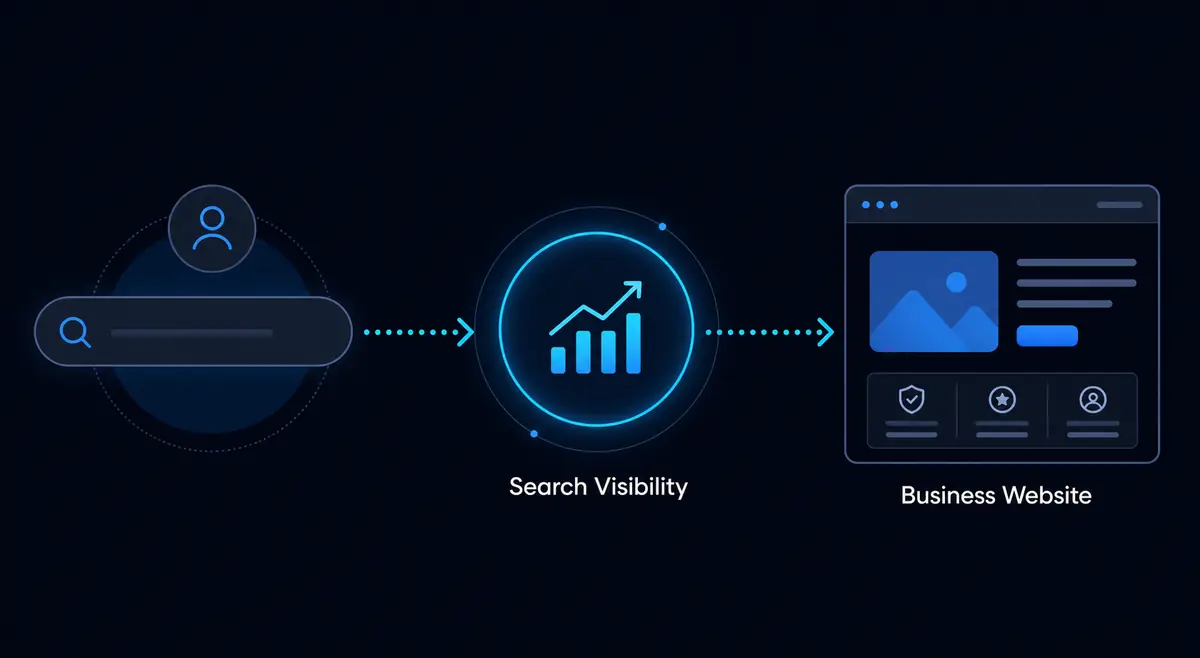
Search visibility creates discoverability
Search visibility helps users discover a business at the moment they are already interested in a topic, product, or service.
For example, a local business owner may search for:
- ?how to improve website traffic?
- ?SEO for small business website?
- ?Google Business Profile optimization?
- ?website audit checklist?
- ?best digital marketing strategy for local business?
If a business website has useful content around these topics, it can become discoverable before the user is ready to make a final decision. This early visibility matters because trust often starts before a direct enquiry.
SEO supports trust before conversion
A user rarely converts only because a website has a contact form. Before taking action, users usually look for signals of clarity, relevance, and credibility.
SEO supports this trust by making the website easier to understand. Clear headings, helpful content, relevant internal links, fast loading pages, and structured information all improve the user?s experience.
For a business website, trust is not built only through design. It is also built through useful explanations, organized pages, and answers that match the user?s actual problem.
Organic traffic compounds over time
Paid ads can bring traffic quickly, but traffic usually stops when the budget stops. SEO works differently. A well-optimized page can continue bringing impressions, clicks, and enquiries over time if it remains relevant and maintained.
This does not mean SEO is free or instant. It requires planning, content creation, technical improvements, monitoring, and updates. But the long-term value of SEO is that useful pages can keep supporting business visibility even after they are published.
For this reason, SEO for Business Websites should be treated as a long-term asset, not a one-time setup.
How SEO Helps a Business Website Perform Better
SEO improves more than rankings. It improves the way a website communicates with users and search engines.
It improves content clarity
A business website should clearly explain what the business does, who it helps, what problems it solves, and why users should trust it.
SEO improves content clarity by forcing every page to answer a specific search intent. Instead of writing vague content, an SEO-focused page answers clear questions.
- What service is offered?
- Who is the service for?
- What problem does it solve?
- What is the process?
- What should the user do next?
This structure helps both users and search engines understand the page.
It strengthens website structure
A strong business website should not be a collection of random pages. It should have a clear structure.
A practical SEO structure may look like this:
- Homepage
- SEO Resource Hub
- Complete SEO Guide for Beginners
- Supporting SEO blogs
- Practical SEO examples
- Contact or service page
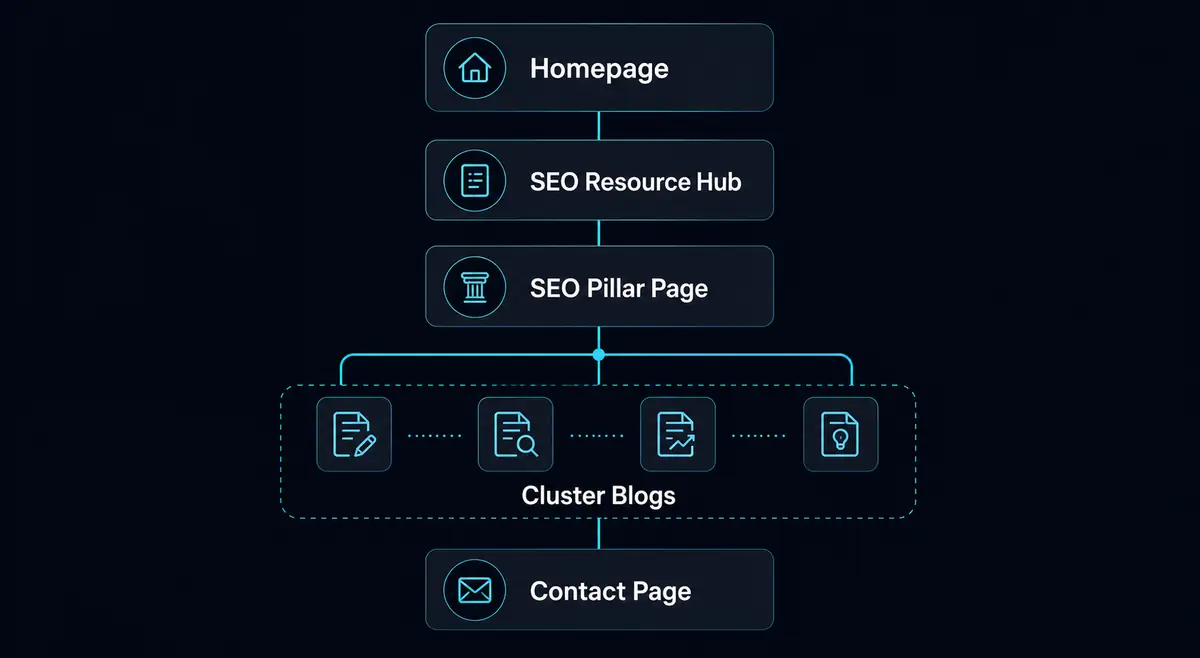
This kind of structure helps search engines understand topic relationships. It also helps users move from general awareness to deeper understanding.
The Complete SEO Guide for Beginners supports this structure by acting as a pillar page for core SEO concepts, while individual blog posts explain specific topics in more detail.
It supports better user experience
Search engines want to show useful pages to users. A website that is slow, confusing, difficult to read, or poorly structured will usually struggle to perform well.
SEO supports user experience through:
- Fast loading pages
- Mobile-friendly design
- Clear navigation
- Readable headings
- Helpful content sections
- Optimized images
- Logical internal links
- Simple calls to action
From a business perspective, this matters because traffic alone does not create growth. Users must be able to understand the page and take the next step.
It connects traffic with business intent
Not every website visitor has the same value. Some users are only browsing. Some are comparing options. Some are ready to contact a business.
SEO helps organize content based on different stages of user intent.
- Awareness: ?What is SEO??
- Consideration: ?SEO for business websites?
- Evaluation: ?SEO audit checklist?
- Action: ?SEO services in Thrissur?
A strong SEO strategy does not depend on one page to do everything. It builds a content system where each page supports a specific stage of the user journey.
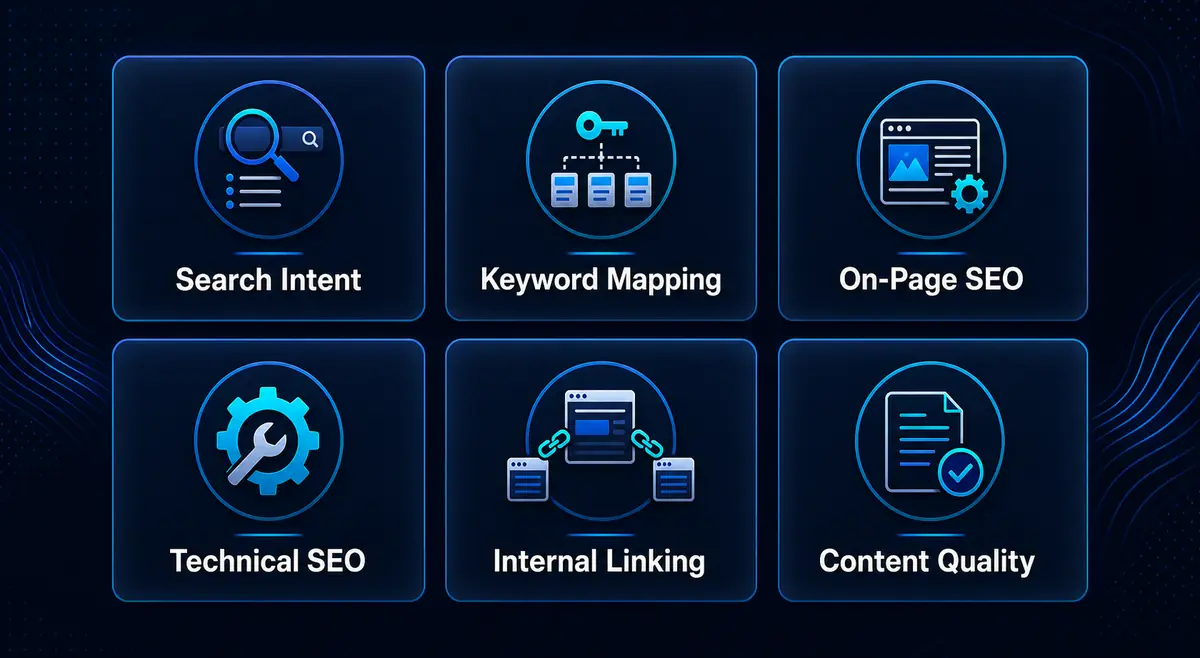
Core Elements of SEO for Business Websites
SEO for Business Websites becomes stronger when the foundation is clear. The most important elements are not complicated, but they must work together.
Search intent
Search intent means understanding why a user is searching. A keyword is not just a phrase. It represents a problem, question, need, or decision stage. Before writing content, it is important to understand whether the user wants information, comparison, service details, local results, or a direct solution.
For example, ?SEO for Business Websites? is not only a keyword. It suggests that the reader wants to understand how SEO helps a business website become more visible and useful.
Keyword mapping
Keyword mapping means assigning one main keyword or topic to one specific page. This prevents keyword cannibalization, where multiple pages compete for the same search term. For a business website, this is important because every page should have a unique role.
A homepage may target a local positioning keyword. A hub page may target a broad topic. A pillar page may target a complete guide keyword. A blog post may target a specific supporting keyword.
On-page SEO
On-page SEO includes the visible and editable parts of a page: SEO title, H1 heading, H2 and H3 headings, meta description, URL slug, image alt text, internal links, content formatting, keyword placement, and CTA placement.
Good on-page SEO does not mean repeating the same keyword everywhere. It means making the page clear, relevant, and easy to understand. An on-page SEO checklist can help business websites review these elements before publishing or updating a page.
Technical SEO
Technical SEO helps search engines crawl, render, index, and understand a website properly.
For a WordPress business website, technical SEO may include:
- Sitemap setup
- Robots.txt review
- Indexing checks
- Page speed improvement
- Mobile usability
- Canonical URLs
- Broken link checks
- Schema markup
- Clean permalink structure
Technical SEO does not replace good content. But if technical foundations are weak, even useful content may struggle to perform.
Internal linking
Internal linking connects related pages within the same website. For a business website, internal links help users discover deeper content and help search engines understand which pages are important.
A blog about SEO for Business Websites should naturally link to the SEO Resource Hub, the SEO pillar page, related SEO checklists, and practical SEO examples. This creates a stronger topical authority structure.
Internal linking is not about adding random links. It is about guiding users through a useful path.
Content quality
Content quality is one of the strongest parts of SEO. A business website should avoid thin, generic, or copied content. Strong content explains the topic clearly, answers real questions, gives examples, and helps the user make better decisions.
Good SEO content usually includes:
- Clear explanation
- Practical examples
- Simple structure
- User-focused answers
- Original insights
- Updated information
- Relevant internal links
- Strong readability
For business websites, content should support both visibility and trust.
Practical SEO Workflow for a Business Website
A simple SEO workflow for a business website can follow this structure:
- Identify the business goal
- Understand the target audience
- Research search intent and keywords
- Map one keyword to one page
- Create or update the page structure
- Optimize title, headings, URL, and meta description
- Add useful content sections
- Add internal links to related pages
- Optimize images and alt text
- Check mobile experience and page speed
- Submit or monitor the page in Google Search Console
- Review impressions, clicks, CTR, and ranking movement over time
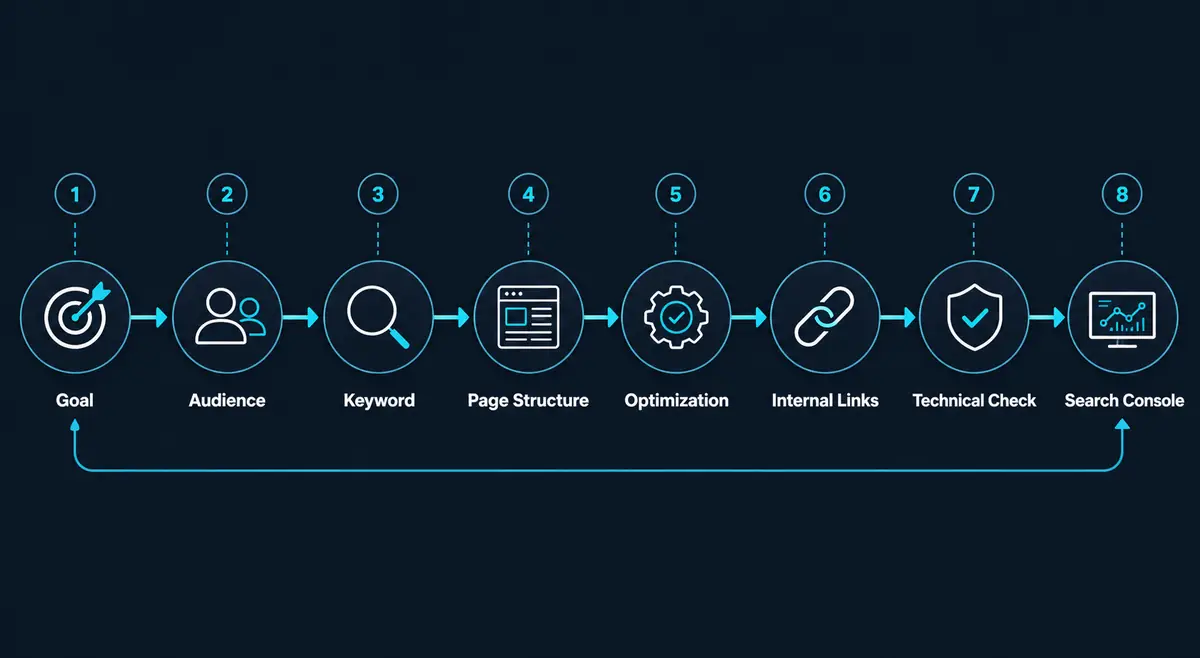
This workflow keeps SEO practical. It avoids the mistake of treating SEO as only content writing or only technical settings.
For a business website, the goal is not just to publish more. The goal is to publish with structure, purpose, and measurable improvement.
Common SEO Mistakes Business Websites Make
Many business websites struggle with SEO because the basics are not connected properly.
- Targeting the same keyword on multiple pages
- Writing content without search intent
- Ignoring page titles and meta descriptions
- Using weak headings
- Publishing thin blog posts
- Not linking related pages together
- Having slow mobile pages
- Ignoring Google Search Console data
- Using large uncompressed images
- Creating service pages with very little useful information
- Depending only on social media traffic
- Treating SEO as a one-time plugin setup
One of the biggest mistakes is believing that installing an SEO plugin is the same as doing SEO. Tools like RankMath can help with optimization, but the real SEO work comes from strategy, structure, content quality, technical health, and continuous improvement.
Example: How SEO Works for a Local Service Website
Consider a local service business website. The homepage may explain the business, location, and main service positioning. The service pages may target specific services. Blog posts may answer common customer questions. The contact page may help users take action.
A simple SEO content structure could look like this:
- Homepage: Main brand and local positioning
- Service page: Specific service offer
- Blog post: Educational answer to a common problem
- Hub page: Organized topic collection
- Pillar page: Complete guide around a major topic
- Case study or proof post: Practical implementation example
For example, a digital marketing portfolio website can use SEO content to show practical understanding. A blog about search visibility explains the foundation. A guide about SEO explains the full concept. A checklist blog explains implementation. A proof post shows how SEO structure was applied on the website.
This is how SEO becomes more than writing. It becomes a system.
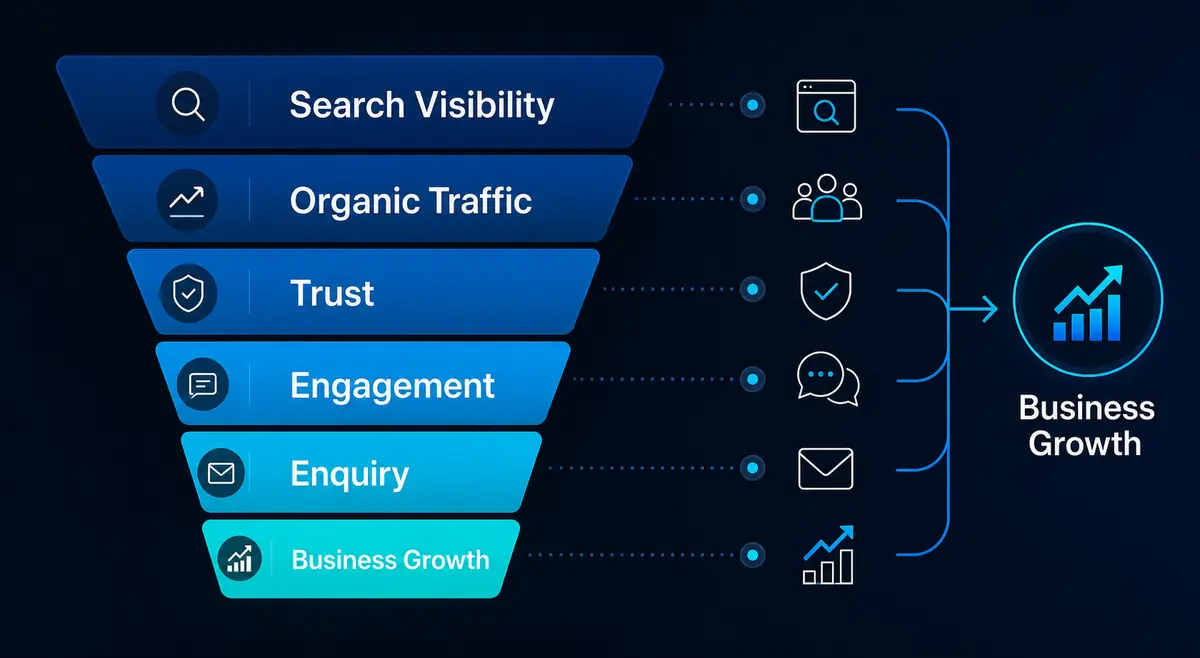
SEO Is Not Just Traffic ? It Supports Business Growth
SEO should not be measured only by traffic. Traffic matters, but business websites need relevant traffic. A page that brings 1,000 random visitors may be less useful than a page that brings 50 highly relevant visitors with strong business intent.
Useful SEO metrics include:
- Impressions
- Clicks
- Click-through rate
- Average position
- Indexed pages
- Top queries
- Top landing pages
- Engagement quality
- Enquiries or conversions
- Assisted conversions
From a performance marketing perspective, SEO supports the wider growth system. Organic search can help users discover the business, content can educate them, internal links can move them deeper, and conversion-focused pages can turn interest into action.
This is why SEO for Business Websites should connect with analytics, CRO, content strategy, and business goals.
A practical SEO audit example shows how business website SEO can be reviewed across indexability, metadata, headings, links, schema and CTAs.
Conclusion
SEO for Business Websites still matters because search visibility is one of the strongest ways to help users discover, understand, and trust a business online.
A business website should not depend only on design, social media, or paid ads. It needs a search-friendly structure, useful content, technical health, clear internal links, and pages that match real user intent.
Strong SEO is not about tricks. It is about making the website easier for search engines to understand and easier for users to use.
For business websites, the real value of SEO is not only ranking. It is long-term visibility, better user experience, stronger trust, and a clearer path from search to business growth.
Continue Reading
FAQ Section
What is SEO for Business Websites?
SEO for Business Websites is the process of improving a business website so search engines can understand it and users can find it through relevant searches. It includes content optimization, technical SEO, internal linking, keyword strategy, and user experience improvements.
Why is SEO important for a business website?
SEO is important because it helps a business website become visible when people search for relevant services, solutions, or information. Better visibility can support trust, organic traffic, enquiries, and long-term digital growth.
Is SEO only about ranking on Google?
No. SEO is not only about rankings. It also improves content clarity, website structure, user experience, crawlability, internal linking, and conversion paths. Rankings matter, but they are only one part of SEO performance.
How long does SEO take for a business website?
SEO usually takes time because search engines need to crawl, index, evaluate, and compare pages. The timeline depends on competition, website quality, content depth, technical health, and consistency.
Can a small business benefit from SEO?
Yes. Small businesses can benefit from SEO by targeting specific services, local searches, customer questions, and long-tail keywords. A well-structured website can improve discoverability even with limited content if the strategy is focused.
What is the first step in SEO for a business website?
The first step is to understand the business goal and map the website?s important pages. Each page should have a clear purpose, target keyword, search intent, and internal linking role.
Want to understand how SEO, content structure, and website optimization work together?
Explore the SEO Resource Hub for practical SEO guides, checklists, and implementation-focused articles.
For professional collaboration or website optimization discussions, visit the Contact page.