A personal brand does not become clear because someone posts every day. It becomes clear when the content repeatedly communicates the same professional direction, useful ideas, proof of work, and practical thinking.
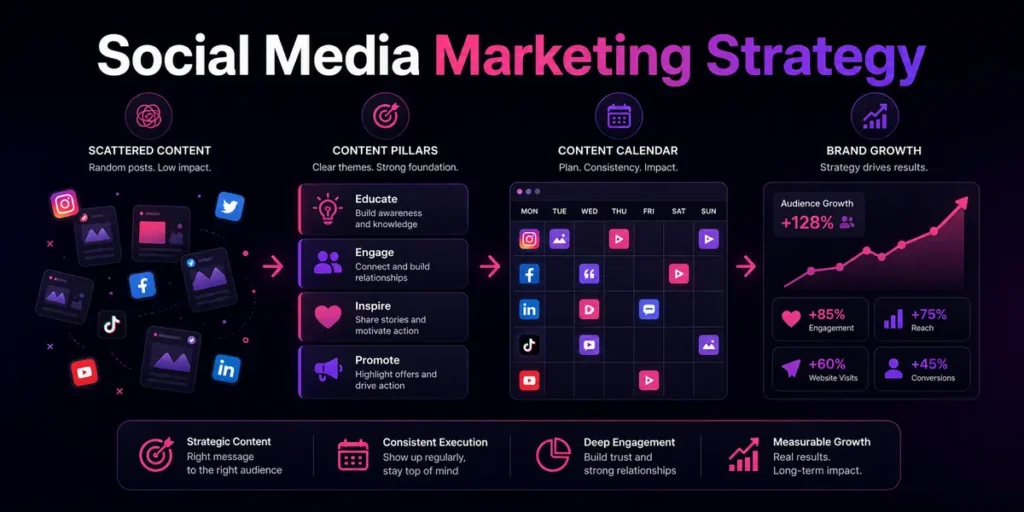
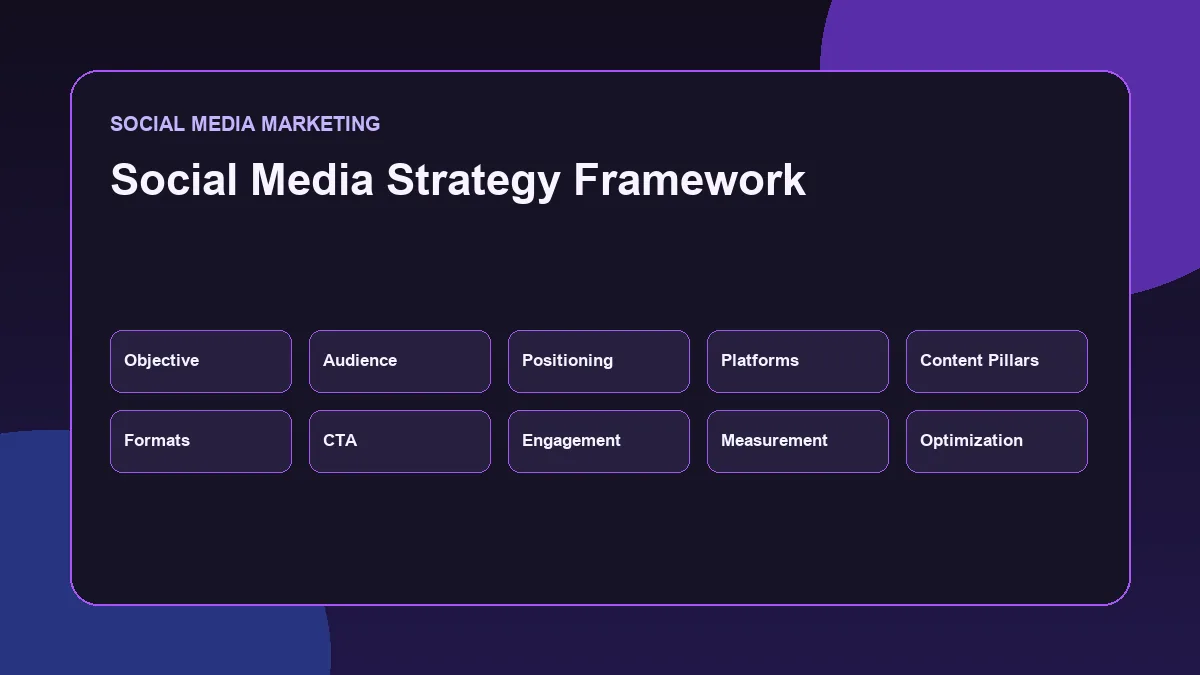
A Social Media Content Strategy Example shows how a personal brand can connect objective, audience, positioning, platform roles, content pillars, publishing rhythm, CTAs, engagement, measurement and optimization into one repeatable content system.
This Social Media Content Strategy Example shows how a professional personal brand can be planned with structure instead of random posting.
The goal is not to become an influencer. The goal is to build a clear and credible content system that supports professional visibility, portfolio strength, recruiter trust, and business understanding.
For a digital marketing personal brand, social media content should answer one question clearly:
What should people understand about the professional after seeing the content for 30 days?
If the answer is unclear, the content strategy needs better positioning.
Strategy Disclosure and Scope
This strategy example is based on a professional digital marketing personal brand and is created as a portfolio demonstration.
It is not a client campaign.
It does not claim:
- Follower growth
- Engagement growth
- Leads generated
- Recruiter messages
- Job offers
- Client enquiries
- Revenue
- Campaign results
- Paid promotion results
The example is designed to show how a structured social media content strategy can be planned for a professional brand focused on SEO, performance marketing, analytics, WordPress, social media marketing, and implementation proof.
The strategy can be adapted for other professionals, but the example here is written for a digital marketing portfolio brand.
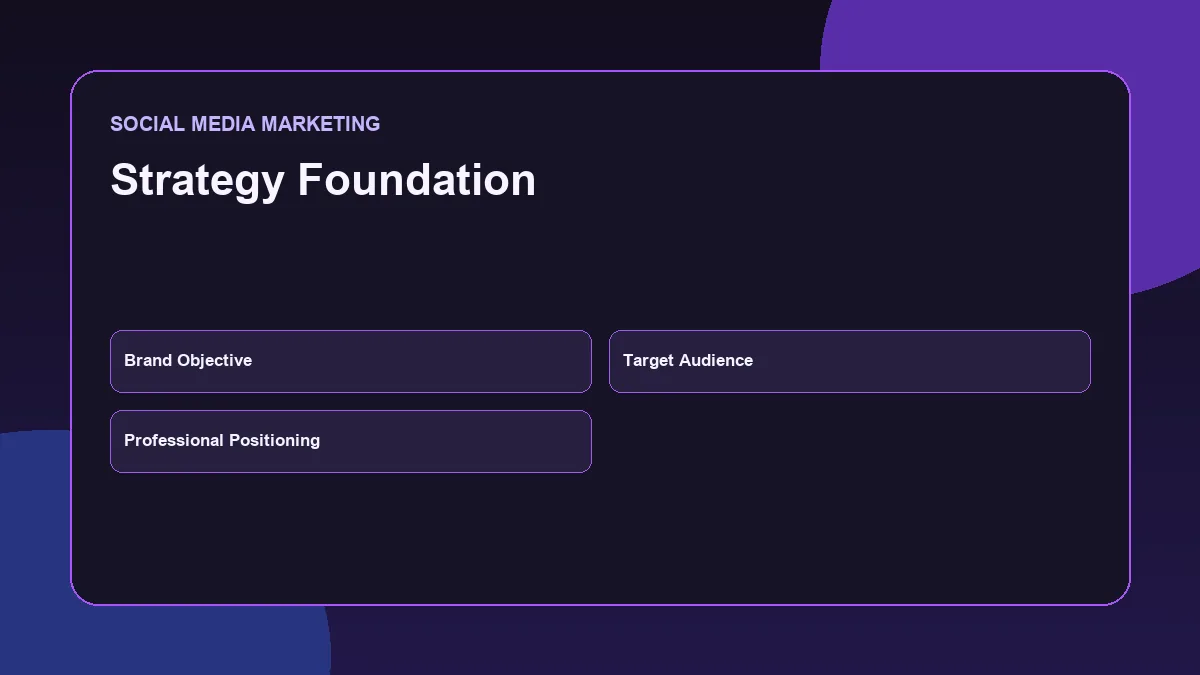
Brand Objective
The first step in a social media content strategy is to define the brand objective.
For this personal brand example, the objective is not entertainment or influencer growth.
The objective is professional positioning.
Primary objective:
Build a clear digital marketing personal brand around SEO, performance marketing, website optimization, analytics, reporting, social media strategy, and practical implementation.
Secondary objectives:
- Increase professional visibility
- Support recruiter trust
- Drive profile visits
- Support portfolio website visits
- Document proof of work
- Build topic clarity
- Improve communication skills
- Create useful content for business owners and marketers
- Support future internship, job, or freelance opportunities
This objective controls the content system.
If the objective is professional trust, the content should not be built only around trends, memes, or motivational quotes. It should show structured thinking and practical knowledge.
Audience Definition
A personal brand should not speak to everyone.
For this example, the target audience includes:
| Audience Segment | What They Care About |
|---|---|
| Recruiters | Skill clarity, communication, consistency, proof of work |
| Marketing managers | Practical thinking, execution ability, reporting awareness |
| Small business owners | Simple explanations, website visibility, lead-generation thinking |
| Digital marketing peers | Frameworks, observations, implementation details |
| Freelance prospects | Trust, clarity, service understanding, professionalism |
| Mentors or trainers | Learning application, structure, growth direction |
The content should be useful for these audiences without becoming scattered.
For example, a post about internal linking can help recruiters see SEO thinking, business owners understand website structure, and peers understand content architecture.
The same content can serve multiple audiences when the core idea is clear.
Professional Positioning
Positioning explains how the brand should be understood.
For this example, the positioning is:
A Kerala-based SEO and performance marketing professional focused on search visibility, website optimization, analytics, content systems, social media strategy, CRO, reporting, and conversion-focused digital growth.
The content should support this positioning repeatedly.
That means the posts should often connect to:
- SEO implementation
- Performance marketing thinking
- Website structure
- Content planning
- Analytics and reporting
- Landing-page improvement
- Social media systems
- Professional proof of work
The content should avoid positioning the brand as:
- A guru
- An influencer
- A course seller
- A fake agency
- A motivational page
- A random digital marketing tips account
- A brand claiming results without proof
A strong personal brand does not need exaggerated claims. It needs consistency, clarity, and proof.
Platform Roles
A content strategy should define the role of each platform.
The same content should not be copied everywhere without context. Each platform has a different function in the brand system.
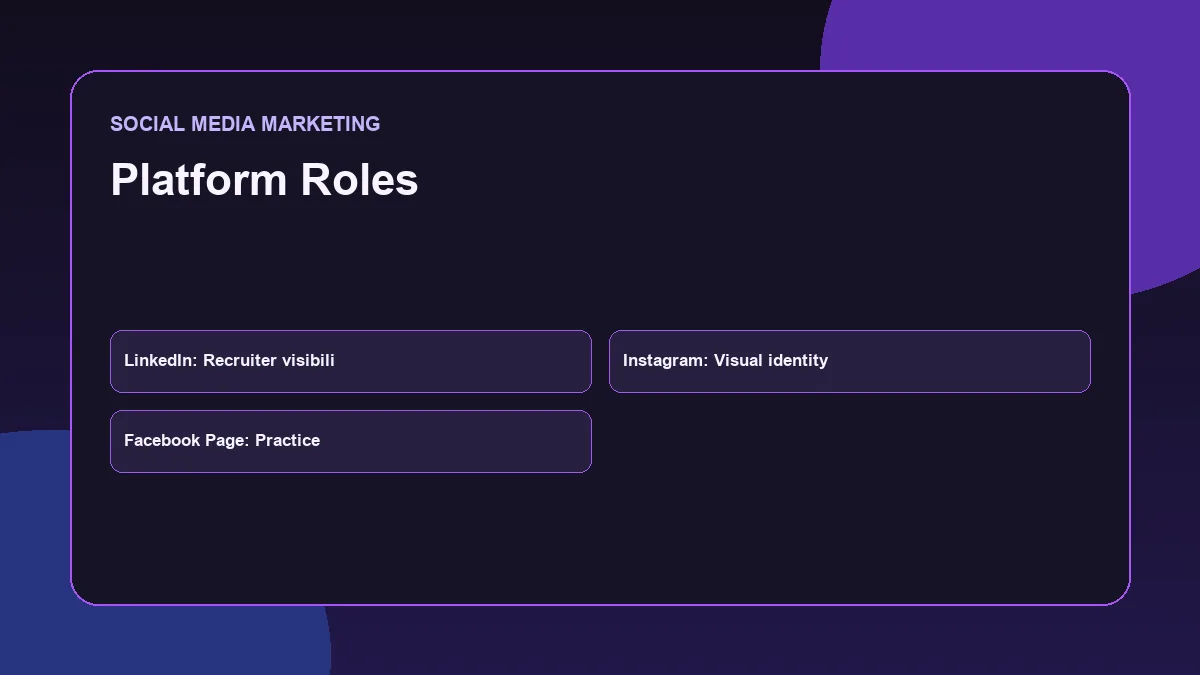
LinkedIn is the primary professional positioning platform.
Main purpose:
- Recruiter visibility
- Professional networking
- Proof-of-work documentation
- Digital marketing thinking
- Portfolio traffic
- Career and freelance credibility
Best content types:
- Text posts
- Proof-of-work posts
- Educational posts
- Reflection posts
- Carousel-style frameworks
- Website or blog breakdowns
- Case-study-style posts without fake results
LinkedIn should show professional thinking clearly.
Instagram supports visual identity, content experiments, and professional recall.
Main purpose:
- Visual proof of work
- Personal brand consistency
- Reels and carousel practice
- Professional presence
- Simple educational content
- Portfolio content repurposing
- Meta content workflow practice
Best content types:
- Carousels
- Reels
- Stories
- Profile highlights
- Short educational posts
- Visual frameworks
- Behind-the-scenes implementation posts
- Website screenshots where appropriate
Instagram should not become a random motivation page. It should support the same professional direction.
Meta’s official Instagram Insights documentation explains that insights can help professional accounts understand followers and improve content for their audience, making measurement useful for a content strategy rather than guesswork. (Instagram Insights)
Facebook Page
The Facebook Page supports professional presence and Meta Business Suite practice.
Main purpose:
- Business presence
- Content publishing practice
- Meta Business Suite workflow
- Page insights review
- Content repurposing from Instagram and LinkedIn
- Local professional visibility
Best content types:
- Repurposed educational posts
- Blog links
- Short updates
- Service-aware posts
- Portfolio proof snippets
- Content calendar experiments
The Facebook Page does not need to be the main growth channel at the beginning. It can support publishing consistency and platform learning.
Meta Business Suite Insights can help review organic and paid activity across a Facebook Page and Instagram account, which makes it useful for tracking content performance across Meta platforms. (Meta Business Suite Insights)
Content Pillars
Content pillars keep the strategy focused.
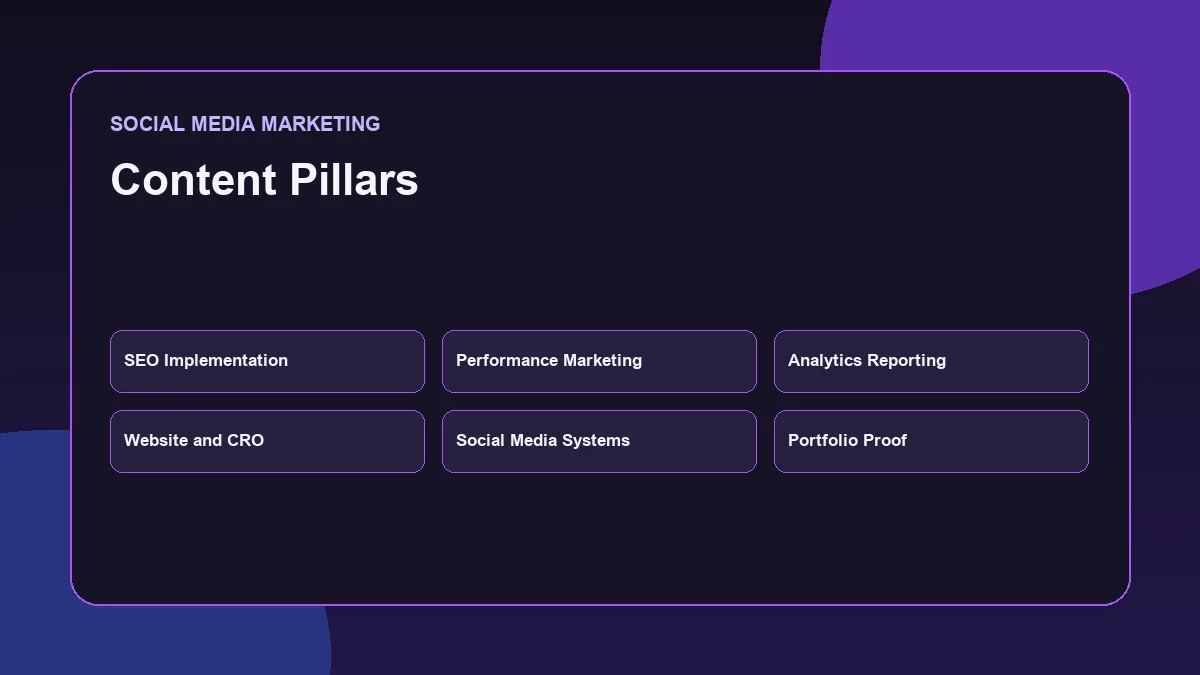
For this personal brand example, six content pillars are enough.
| Content Pillar | Purpose | Example Topic |
|---|---|---|
| SEO implementation | Show search visibility knowledge | Internal linking strategy for SEO blogs |
| Performance marketing | Show campaign and funnel thinking | Why traffic needs tracking and landing pages |
| Analytics and reporting | Show measurement awareness | GA4 reporting workflow for campaign analysis |
| Website and CRO | Show conversion thinking | Contact forms as conversion points |
| Social media systems | Show structured content thinking | Why random posting does not build positioning |
| Portfolio proof | Show practical implementation | Website hub, pillar, and blog structure breakdown |
Each pillar should support the same professional identity.
A weak content strategy jumps between unrelated topics. A strong content strategy repeats important themes from different angles.
For example, one topic such as “landing pages” can support multiple pillars:
- Performance marketing: Landing page as paid traffic destination
- CRO: CTA clarity and form friction
- Analytics: Tracking landing-page actions
- SEO: Search intent and content structure
- Portfolio proof: Breakdown of a real page section
This creates depth without repetition.
Content Formats
A content strategy should define formats before publishing.
Different formats serve different purposes.
| Format | Best Use |
|---|---|
| Text post | Clear explanation, reflection, professional observation |
| Carousel | Frameworks, checklists, step-by-step ideas |
| Reel | Short explanation, quick concept, visual walkthrough |
| Story | Updates, behind-the-scenes, small observations |
| Screenshot breakdown | Proof of work, website or dashboard explanation |
| Blog repurposing post | Turning long-form content into social content |
| Checklist post | Practical saves and shares |
| Poll or question post | Audience insight and engagement |
For this personal brand, the strongest formats are:
- LinkedIn text posts
- Instagram carousels
- Instagram stories
- Portfolio screenshots
- Blog repurposing posts
- Short educational reels
- Checklist-style posts
The goal is not to use every format every week. The goal is to choose formats that support clarity and proof.
Publishing Rhythm
Consistency should be realistic.
A practical weekly rhythm may look like this:
| Day | Platform | Content Type | Purpose |
|---|---|---|---|
| Monday | Educational post | Explain one useful concept | |
| Tuesday | Carousel | Repurpose the concept visually | |
| Wednesday | Facebook Page | Short post or blog link | Maintain page activity |
| Thursday | Proof-of-work post | Show implementation thinking | |
| Friday | Instagram Story | Behind-the-scenes update | Keep profile active |
| Saturday | LinkedIn or Instagram | Reflection post | Share practical observation |
| Sunday | Planning | Review and prepare | Improve next week’s content |
This rhythm can be adjusted depending on time and quality.
A smaller version may be:
- Two LinkedIn posts per week
- Two Instagram posts per week
- One Facebook Page update per week
- Three to five stories per week
- One weekly measurement review
The strategy should not force daily posting if quality drops.
CTA Structure
A CTA guides the next action.
For a personal brand, the CTA should not always be promotional. It should match the content type.
| CTA Type | Purpose | Example |
|---|---|---|
| Engagement CTA | Start comments | What would you add to this checklist? |
| Reflection CTA | Invite experience | Have you noticed this issue on business websites? |
| Save CTA | Encourage future use | Save this if you plan content for a professional brand. |
| Portfolio CTA | Drive website visits | I documented the full workflow on my website. |
| Soft conversion CTA | Open professional contact | Review my services or contact page if your website needs a clearer SEO structure. |
The CTA should be natural.
A proof-of-work post can invite people to review the full portfolio article. An educational post can ask a practical question. A service-aware post can point to the services page. A blog repurposing post can invite readers to continue on the website.
Avoid aggressive CTAs such as:
- Buy now
- DM me fast
- Limited slots
- Guaranteed growth
- Get 10x results
- I will make your brand viral
Professional CTAs should feel useful, not desperate.
Engagement Plan
Social media strategy is not only publishing. It also includes engagement.
For this personal brand, engagement should focus on professional conversations.
Useful engagement actions:
- Reply to comments on posts
- Comment on recruiter, agency, and marketer posts
- Add practical observations
- Ask clear questions
- Share relevant professional updates
- Connect with local business owners carefully
- Avoid spam messages
- Avoid generic comments
- Support peer learning discussions
Example of a weak comment:
“Great post.”
Example of a stronger comment:
“This connects with landing-page message match. If the ad promises one thing and the landing page headline says something else, conversion tracking alone cannot solve the issue.”
The stronger comment demonstrates thinking.
A simple weekly engagement plan:
| Activity | Frequency |
|---|---|
| Reply to all meaningful comments | After every post |
| Comment on relevant LinkedIn posts | 10–15 per week |
| Engage with local business pages | 5–8 per week |
| Save useful industry posts | Weekly |
| Track repeated audience questions | Weekly |
| Convert useful questions into content | Weekly |
Engagement should support positioning, not distract from it.
Measurement Framework
Measurement keeps the content strategy practical.
The goal is not only to count likes. The goal is to understand whether the content is building the right professional signals.
Useful metrics include:
| Metric | What It Shows |
|---|---|
| Reach or impressions | How many times content was seen |
| Engagement | Whether people interacted |
| Comments | Whether the content started useful conversation |
| Saves | Whether the content had practical value |
| Shares | Whether people found it useful enough to pass on |
| Profile visits | Whether content created interest in the person |
| Website clicks | Whether social content supports portfolio visits |
| Follower quality | Whether relevant people are connecting |
| DM quality | Whether conversations are professional and relevant |
| Content pillar performance | Which topics attract the right audience |
Meta Business Suite provides insights for organic and paid activity across Facebook and Instagram, which can support review of content performance across Meta platforms. (Meta Business Suite Insights)
For LinkedIn, measurement should include:
- Impressions
- Reactions
- Comments
- Shares
- Profile views
- Search appearances
- Website clicks
- Recruiter or professional engagement quality
A simple monthly review can ask:
- Which content pillar performed best?
- Which posts created meaningful comments?
- Which posts led to profile visits?
- Which formats were easiest to produce consistently?
- Which topics should be repeated from a new angle?
- Which topics did not support positioning?
- Which posts can become blogs or portfolio proof?
Measurement should improve the next month’s content.
Optimization Process
A content strategy should improve over time.
Optimization does not mean changing the entire strategy every week. It means making small improvements based on patterns.
Step 1: Review Content Pillars
Check which pillars are being posted consistently.
If all posts are about motivation and none are about SEO, performance marketing, analytics, or proof of work, the strategy is drifting.
Step 2: Review Audience Response
Look at comments, saves, profile visits, and website clicks.
The strongest content is not always the content with the most likes. It is the content that attracts the right audience.
Step 3: Review Format Performance
Check whether text posts, carousels, reels, stories, or screenshot breakdowns are working better for the intended goal.
Step 4: Improve Hooks and Structure
If posts are not being read, improve the opening lines, spacing, and clarity.
Step 5: Repurpose Strong Topics
If a topic performs well, reuse the idea in another format.
Example:
- Blog → LinkedIn post
- LinkedIn post → Instagram carousel
- Carousel → Reel script
- Reel → Story summary
- Story question → New blog idea
Step 6: Remove Weak Patterns
Stop repeating content that does not support positioning.
For example, if generic motivational quotes do not attract the right audience, reduce them.
Step 7: Document Learnings
Keep a simple content review sheet.
Columns can include:
- Date
- Platform
- Pillar
- Format
- Topic
- CTA
- Reach
- Engagement
- Saves
- Comments
- Profile visits
- Website clicks
- Learning
- Next action
This turns content creation into a measurable workflow.
Example Content Map
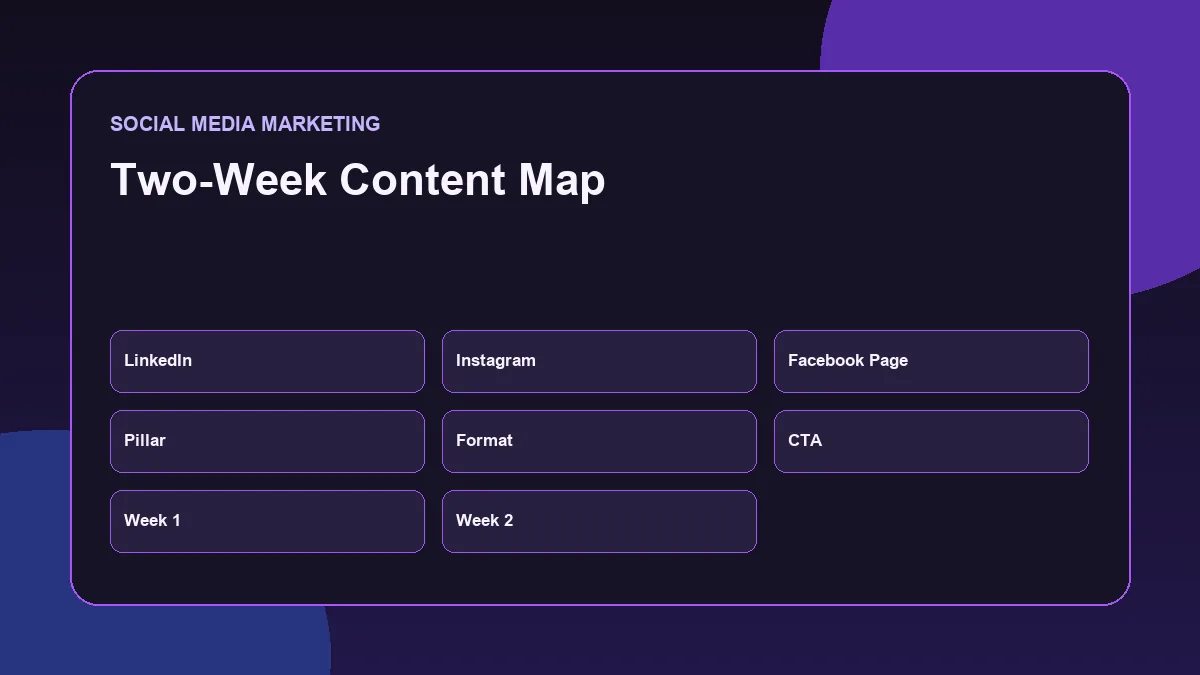
Here is a 2-week sample content map for the personal brand.
| Day | Platform | Pillar | Format | Topic | CTA |
|---|---|---|---|---|---|
| Monday | SEO implementation | Text post | Why internal links support topical authority | Ask: What do you check before publishing a blog? | |
| Tuesday | SEO implementation | Carousel | Hub → Pillar → Cluster → Proof structure | Save CTA | |
| Wednesday | Facebook Page | Portfolio proof | Blog link | Internal linking strategy article | Visit blog CTA |
| Thursday | Analytics | Text post | GA4 reports should end with action | Ask: What metric do you review first? | |
| Friday | Instagram Story | Website/CRO | Screenshot | Contact form as conversion point | Poll: Is your form tested? |
| Saturday | Portfolio proof | Breakdown post | Website SEO audit structure | Portfolio CTA | |
| Sunday | Planning | Measurement | Review sheet | Weekly content performance review | Internal review |
| Monday | Performance marketing | Text post | Why campaign structure matters before budget | Ask: Campaign or landing page first? | |
| Tuesday | Performance marketing | Carousel | Google Ads plan elements | Save CTA | |
| Wednesday | Facebook Page | SMM systems | Short post | Why random posting fails | Comment CTA |
| Thursday | Website/CRO | Text post | Landing-page CTA clarity | Ask: What makes you trust a page? | |
| Friday | Instagram Story | Portfolio proof | Behind-the-scenes | Blog formatting in Elementor | Website CTA |
| Saturday | Reflection | Text post | What content calendars teach about consistency | Reflection CTA | |
| Sunday | Planning | Measurement | Review sheet | Monthly topic planning | Internal review |
This content map is not meant to be copied forever. It shows how strategy can become a publishing system.
Common Strategy Mistakes
The first mistake is posting without positioning.
If the profile posts about digital marketing one day, lifestyle the next day, random motivation the next day, and unrelated trends after that, the audience may not understand the brand.
The second mistake is creating content only for reach.
Reach is useful, but professional content should also build trust, clarity, and evidence.
The third mistake is hiding the proof of work.
A digital marketing personal brand should show practical work: checklists, workflows, audits, blog structures, reporting plans, website improvements, and content systems.
Other mistakes include:
- Posting without a content pillar
- Using too many unrelated hashtags
- Copying generic marketing tips
- Not replying to comments
- Not reviewing performance
- Not connecting social content to the website
- Using fake client results
- Claiming expertise without evidence
- Overusing motivational content
- Ignoring platform roles
- Not tracking profile visits or website clicks
- Publishing without a CTA
- Using the same format for every idea
A strong personal brand content strategy is not loud. It is focused.
Social Media Content Strategy Checklist
Use this checklist before publishing a personal-brand content plan.
| Checkpoint | Question |
|---|---|
| Objective | Is the main goal clear? |
| Audience | Is the content written for the right people? |
| Positioning | Does the strategy support professional identity? |
| Platforms | Does each platform have a defined role? |
| Content pillars | Are the main topics clear and repeatable? |
| Formats | Are formats matched to the message? |
| Publishing rhythm | Is the schedule realistic? |
| CTA structure | Does each post guide a useful next action? |
| Engagement plan | Is there a plan for comments and networking? |
| Measurement | Are the right metrics being tracked? |
| Optimization | Is there a review process? |
| Portfolio connection | Does the content support website or proof-of-work visibility? |
| Claims | Are fake results and exaggerated positioning avoided? |
This checklist keeps the content strategy practical and professional.
Conclusion
A Social Media Content Strategy Example becomes useful when it shows how positioning, audience, platforms, content pillars, formats, CTAs, engagement, measurement, and optimization work together.
For a professional personal brand, the goal is not random visibility. The goal is clear professional recall.
The audience should repeatedly understand what the person does, what topics they think about, what work they can document, and how their content connects to business and marketing outcomes.
A strong content strategy does not need fake claims or viral promises. It needs consistent positioning, practical proof, clear communication, and measured improvement.
FAQs
What is a social media content strategy example?
A social media content strategy example shows how a brand or professional can plan content around objectives, audience, positioning, platforms, content pillars, formats, CTAs, engagement, and measurement.
How do I create a content strategy for a personal brand?
Start by defining your objective, target audience, professional positioning, platform roles, content pillars, publishing rhythm, CTA structure, engagement plan, and measurement framework.
What should a digital marketing personal brand post?
A digital marketing personal brand can post about SEO, performance marketing, analytics, social media strategy, website optimization, CRO, content planning, reporting workflows, audits, and proof-of-work examples.
How many content pillars should a personal brand have?
A personal brand usually needs four to six strong content pillars. Too many pillars can make the brand unclear, while too few may limit content variety.
Should a personal brand post on every platform?
No. A personal brand should choose platforms based on goals and capacity. For professional positioning, LinkedIn may be primary, while Instagram and Facebook Page can support visual content, practice, and platform presence.
How should social media content performance be measured?
Performance should be measured using reach, engagement, comments, saves, shares, profile visits, website clicks, follower quality, DM quality, and whether the content supports the intended positioning.
Related Social Media Marketing Resources
- Social Media Marketing Guide
- Social Media Marketing Strategy
- Instagram Profile Optimization Checklist
- Social Media Content Calendar
- Social Media Metrics
- LinkedIn Content System
Professional Support
If you need structured content planning for a website or professional brand, review the digital marketing services page or contact Deepak Ramachandran.
Next Step
Explore the Social Media Marketing Resource Hub for related content planning guides, or review the Social Media Marketing Guide to understand how personal-brand content fits into a complete social media strategy.