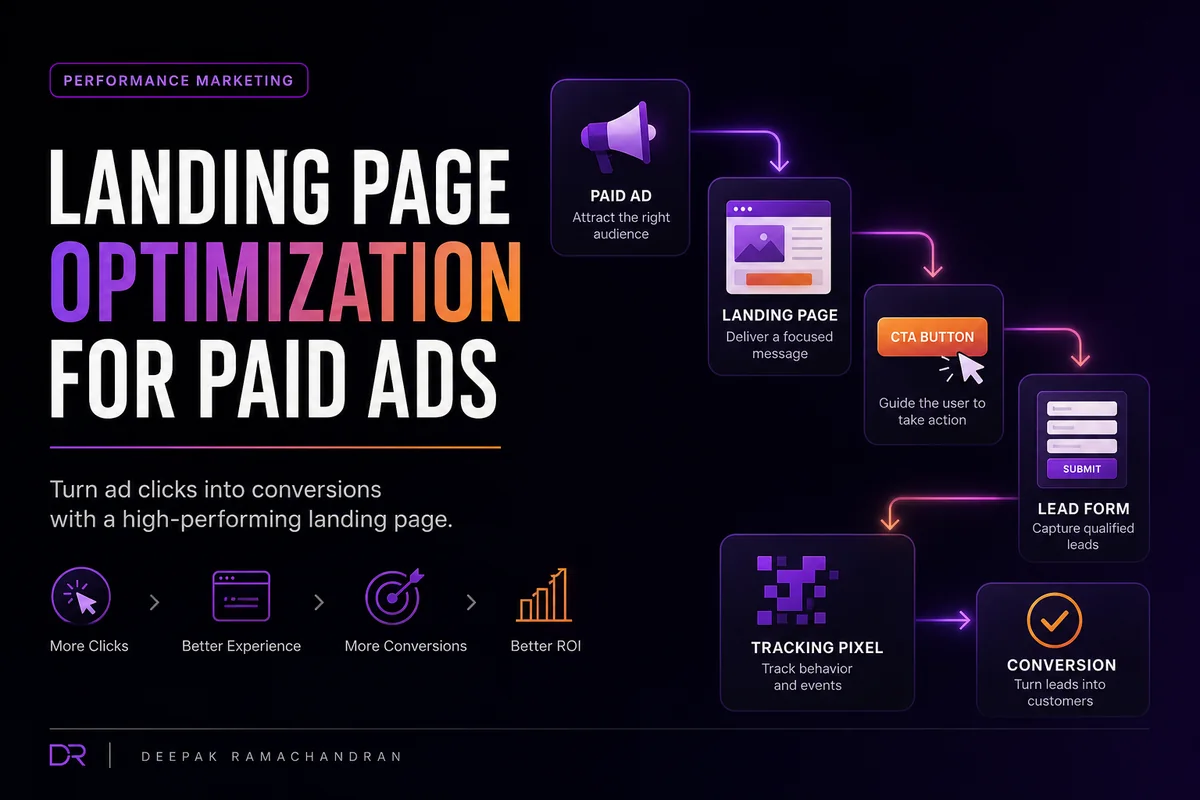
Landing Page Optimization for Paid Ads is the process of improving the page users visit after clicking an ad so that the page matches their intent, explains the offer clearly, builds trust, and guides them toward a conversion.
In performance marketing, the ad does not complete the job alone. The ad creates the click, but the landing page handles the decision.
A campaign can have strong targeting, good ad copy, and a proper budget, but if the landing page is confusing, slow, generic, or disconnected from the ad promise, paid traffic can get wasted quickly.
That is why landing page optimization is a core part of paid ads strategy. It connects campaign planning, user psychology, CRO, tracking, and business goals.
On this website, the Performance Marketing Resource Hub is structured to connect topics like Google Ads, conversion tracking, campaign planning, GA4 reporting, CRO, and landing page optimization into one practical performance marketing system.
A GA4 landing-page performance analysis helps connect landing-page traffic, engagement, events and key events before making optimization decisions.
What makes a landing page effective for paid advertising? A landing page is effective for paid advertising when it matches the ad message, answers the visitor intent quickly, explains the offer clearly, builds trust and makes the conversion action easy to complete. It should be measured with conversion tracking so changes are reviewed with evidence instead of visual preference alone.
What is message match between an ad and landing page?
Message match means the landing page headline, offer and content continue the promise made in the ad. When users see the same intent and benefit after clicking, they are less likely to feel misled or leave immediately.
Which landing-page elements influence conversion decisions?
Conversion decisions are influenced by headline clarity, offer relevance, proof, form length, page speed, CTA visibility, mobile layout, objections answered and trust signals. The page should reduce friction while keeping the action honest and specific.
How should landing-page improvements be tested?
Landing-page improvements should be tested by changing one meaningful element at a time when possible and comparing conversion data, user behavior and lead quality. Small tests can include headline clarity, CTA placement, form fields or trust sections.
- Ad Search Intent
- Ad Message
- Landing Page Headline
- Offer
- Trust
- CTA
- Conversion
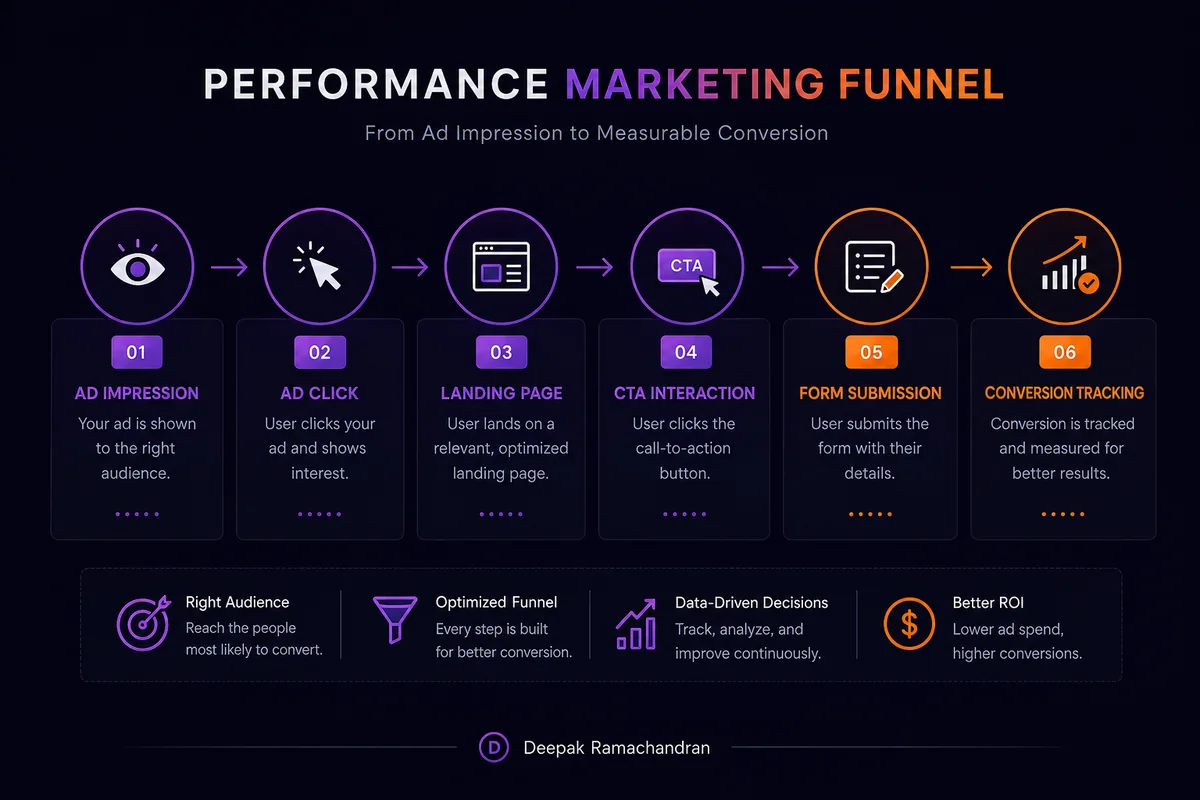
This original visual is provided as readable HTML so users and search systems can understand the full process without relying only on an image.
Simulated example: A service landing page may align the ad keyword with the headline, explain the offer, show trust signals and keep one primary CTA visible on mobile and desktop.
Related reading and topical path
This article connects to its hub, guide and related supporting articles.
- /performance-marketing-resource-hub/
- /performance-marketing-guide/
- /google-ads-campaign-structure/
- /conversion-tracking-basics/
Written by Deepak Ramachandran
Reviewed/updated: June 16, 2026
Table of Contents
- What Is Landing Page Optimization for Paid Ads?
- Why Landing Pages Matter in Performance Marketing
- How Paid Ads and Landing Pages Work Together
- Landing Page Optimization Checklist for Paid Ads
- Common Landing Page Mistakes in Paid Ads Campaigns
- Practical Example: Landing Page Flow for a Local Service Campaign
- Final Landing Page Optimization Checklist
- FAQ Section
What Is Landing Page Optimization for Paid Ads?
A landing page is the page where users arrive after clicking an ad. Landing page optimization means improving that page so users can quickly understand what is being offered, who it is for, why it matters, what action they should take, why they should trust the business, and what happens after they submit a form or click a button.
For paid ads, the landing page should not feel like a random website page. It should feel like a continuation of the ad.
If the ad says “Book a free consultation for dental implants,” the landing page should not send users to a generic homepage with multiple unrelated services. It should take them to a clear dental implant consultation page.
This is called message match. Message match means the keyword, ad copy, offer, page headline, content, and CTA all support the same intent.
From a performance marketing perspective, this matters because every paid click has a cost. When the landing page is weak, the campaign may still get clicks, but conversions may stay low.
Why Landing Pages Matter in Performance Marketing
Paid ads bring traffic. Landing pages convert traffic. That difference is important.
A Google Ads or Meta Ads campaign usually has multiple moving parts: audience or keyword targeting, campaign objective, ad copy, creative, budget, bidding, landing page, conversion tracking, reporting, and optimization.
The landing page sits in the middle of the funnel. It receives attention from the ad and turns that attention into action.
Google Ads also treats landing page experience as part of ad quality diagnostics. Google Ads landing page experience guidance explains how landing page relevance, usefulness, transparency, and ease of navigation affect the experience after someone clicks an ad.
A better landing page can support higher conversion rate, better lead quality, lower wasted spend, clearer campaign learning, better user experience, stronger trust, cleaner reporting, and better ad-to-page consistency.
For small businesses, landing page quality can directly affect lead generation. A user may be interested, but if the page is slow, unclear, or difficult to use on mobile, they may leave without taking action.
This is why landing page optimization should be planned before scaling the ad budget. For the wider paid growth structure, this topic connects with the Performance Marketing Guide.
How Paid Ads and Landing Pages Work Together
Paid ads and landing pages should not be treated separately. They should work as one connected funnel.
Ad intent
Every paid ad is connected to a user intent. In Google Search Ads, intent usually comes from the keyword or search term. Someone searching “best skin clinic in Thrissur” may have a different intent from someone searching “what is chemical peeling.”
The first user may be closer to booking. The second user may still be researching. The landing page should match that intent.
For high-intent service keywords, the page should quickly explain the service, location, benefits, trust factors, process, and booking action. For awareness campaigns, the page may need more education, examples, and softer CTAs.
Message match
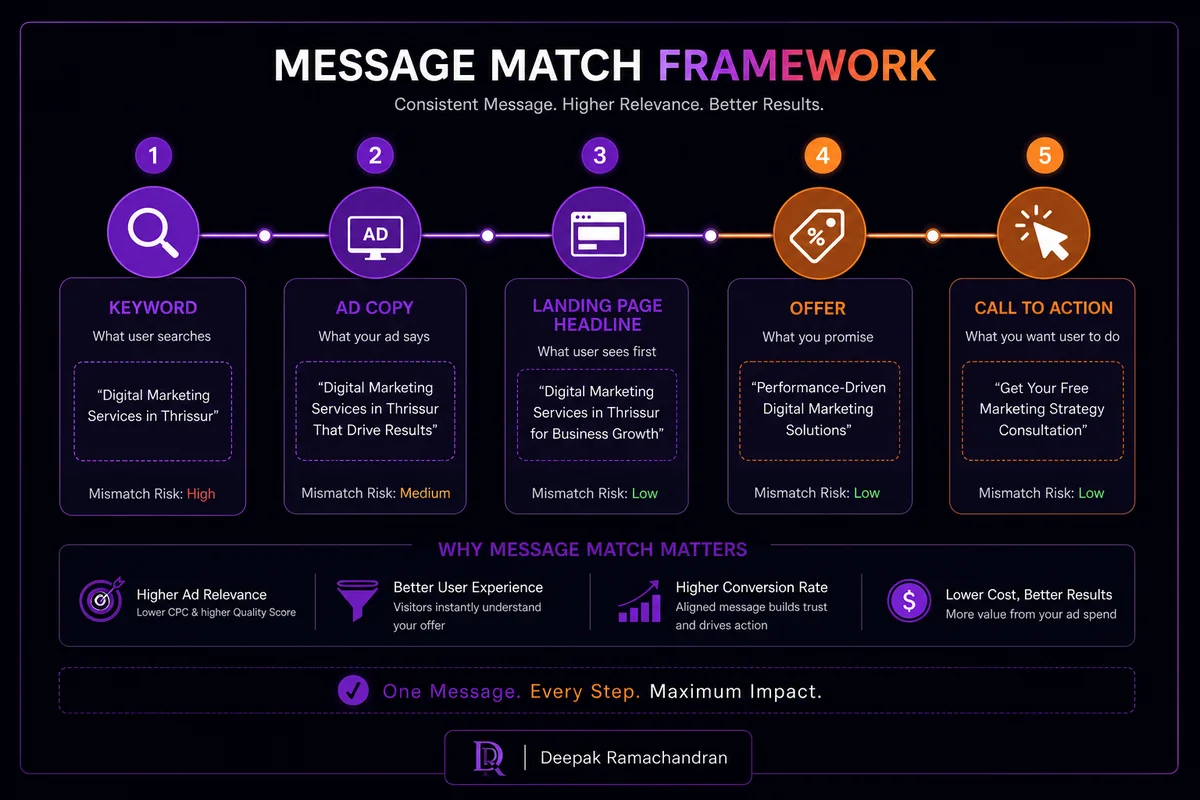
Message match means the ad and landing page feel connected. The user should not feel like they clicked one promise and landed on a different topic.
Strong message match includes similar headline language, the same offer, the same service focus, the same location focus if relevant, the same CTA, the same audience promise, similar visual direction, and a consistent trust-building flow.
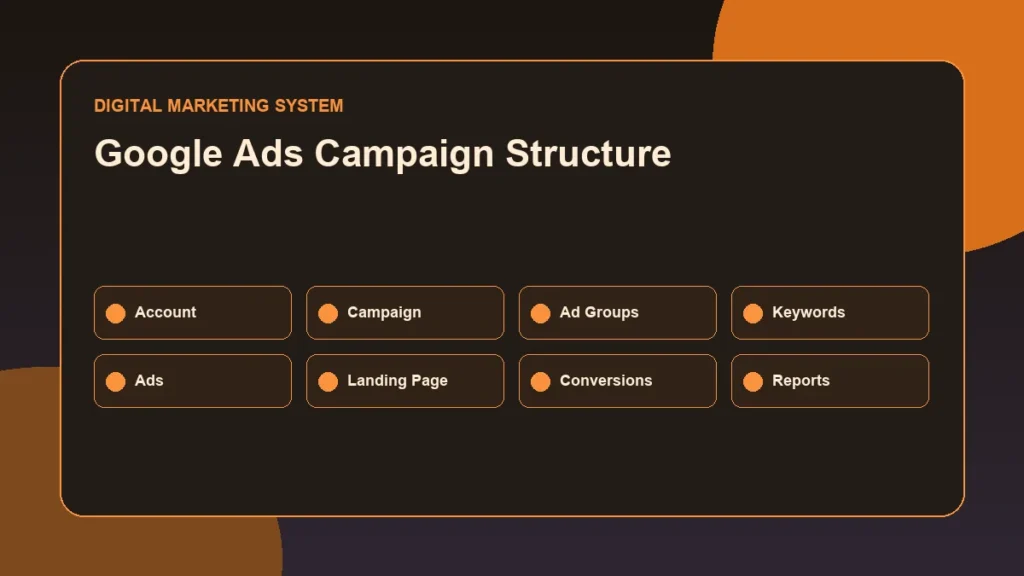
This also connects with Google Ads campaign structure, because campaign organization, keyword intent, ad groups, and landing pages should support the same conversion goal.
Conversion action
Every paid ads landing page should have a clear conversion action. Examples include submitting an enquiry form, calling the business, booking an appointment, downloading a brochure, starting a WhatsApp chat, requesting a quote, registering for a demo, buying a product, or signing up for a trial.
The conversion action should match the campaign objective. If the campaign goal is lead generation, the landing page should not distract users with too many unrelated actions. A focused page usually works better than a page trying to do everything.
Landing Page Optimization Checklist for Paid Ads
Use this checklist before sending paid traffic to a landing page.
1. Match the landing page with the ad promise
The landing page headline should clearly reflect what the user clicked for. If the ad promise is “Get a free website SEO audit for your business,” a weak landing page headline would be “Welcome to Our Digital Marketing Services.” A better headline would be “Get a Practical SEO Audit for Your Business Website.”
A strong landing page should answer the user’s first question immediately: “Am I in the right place?” If the answer is not clear within a few seconds, the page needs improvement.
2. Write a clear above-the-fold section
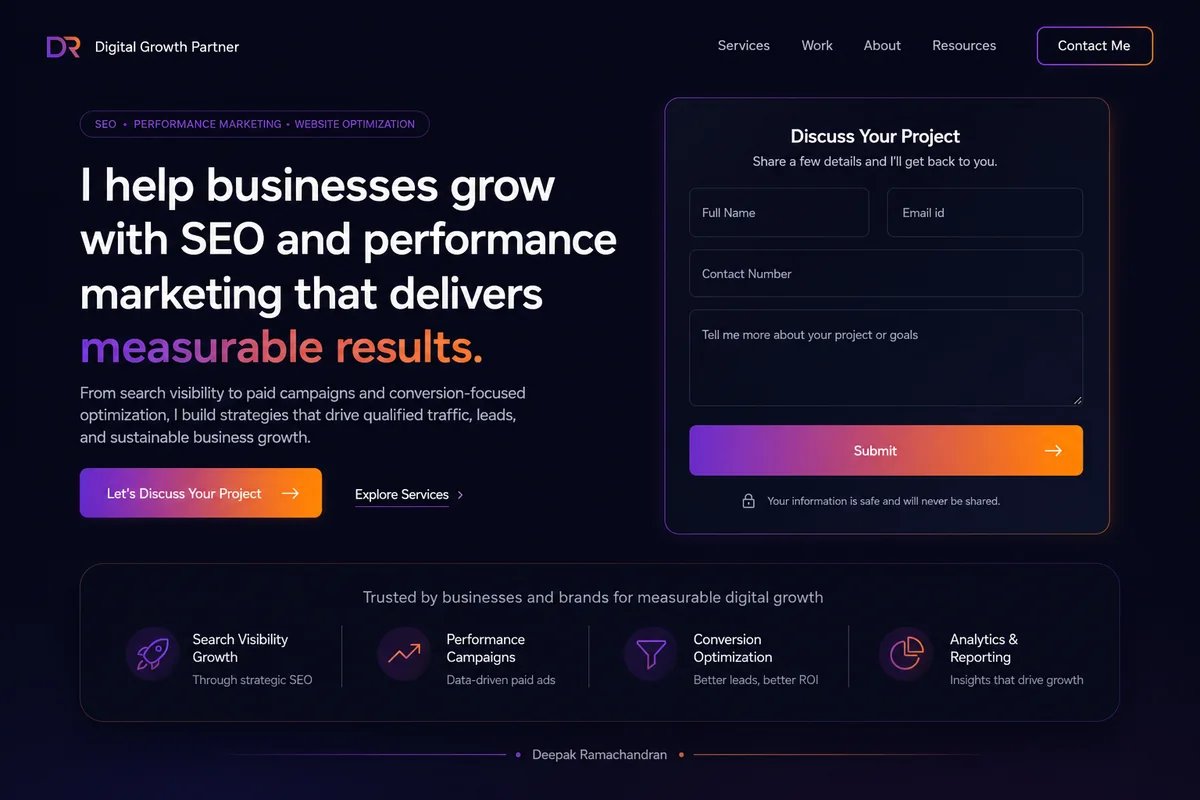
The above-the-fold section is the first visible area users see before scrolling. For paid ads, this section should be simple and focused.
It should include a clear headline, short supporting text, primary CTA, relevant visual, trust signal if available, service or offer clarity, and no unnecessary clutter.
A good above-the-fold section does not need to explain everything. Its job is to make the user continue.
Example structure: headline, “Performance-focused landing pages for paid ad campaigns”; subtext, “Improve message match, form clarity, mobile experience, and conversion tracking before scaling campaign budgets”; CTA, “Request a landing page review”; trust signal, “Built around SEO, CRO, analytics, and performance marketing workflows.”
3. Keep one primary conversion goal
One landing page should have one main goal. If the goal is lead generation, keep the page focused on enquiry or booking.
Avoid giving equal importance to reading a blog, visiting the homepage, following Instagram, downloading an unrelated PDF, viewing all services, watching a random video, subscribing to a newsletter, or contacting multiple departments.
This does not mean the page cannot have supporting links. But the main CTA should be clear and repeated naturally across the page.
4. Make the call to action specific
A weak CTA creates uncertainty. Generic CTA examples include Submit, Click here, Learn more, Send, and Continue.
Better CTA examples include Book a free consultation, Request a campaign audit, Get a landing page review, Start your enquiry, Download the checklist, Check pricing options, and Schedule a strategy call.
The CTA should tell users what action they are taking. For paid ads, CTA clarity matters because the user may not know the business yet. The page should reduce hesitation.
5. Improve mobile experience
Many paid ad clicks happen on mobile devices. A landing page that works on desktop but feels difficult on mobile can waste campaign spend.
Mobile checks include readable headline, visible CTA, easy form fields, tappable buttons, working WhatsApp or call buttons, optimized images, no horizontal scrolling, clean sections, sticky elements that do not block content, and fast loading.
For local service campaigns, mobile experience is especially important because users may call, message, or submit a quick enquiry directly from their phone.
6. Increase page speed
Paid traffic should not be sent to a slow page. A slow landing page can create higher bounce rate, lower conversion rate, poor user experience, wasted click cost, weak mobile performance, and incomplete form submissions.
Common speed issues include large images, too many scripts, heavy page builder sections, uncompressed files, autoplay videos, too many plugins, no caching, slow hosting, and unused tracking scripts.
For WordPress and Elementor landing pages, image compression, caching, minimal plugins, and clean section design are important. A premium landing page does not need to be heavy. It should look professional and load smoothly.
7. Use trust signals carefully
Users need reasons to trust the landing page. Trust signals can include testimonials, client logos, certifications, case study links, process explanation, before-after examples, portfolio samples, business address, contact details, privacy note near forms, real team or founder information, relevant credentials, and clear service explanation.
But trust signals should be honest. Do not add fake reviews, fake client logos, fake ratings, or fake numbers. For a portfolio website, it is better to show real proof-of-work, clearly labelled simulated examples, audit breakdowns, dashboards, and practical workflows.
Trust should come from clarity and proof, not exaggeration.
8. Reduce form friction
Forms are often where conversions fail. A form may look simple, but if it asks too much too early, users may avoid completing it.
For lead generation campaigns, ask only what is needed at that stage. Basic form fields may include name, phone number, email, service needed, and message or requirement.
Form optimization checks include whether the form is visible, easy to complete on mobile, clearly labelled, supported by a specific submit button, backed by privacy reassurance, connected to a clear thank-you message, and tracked as a conversion.
9. Add conversion tracking
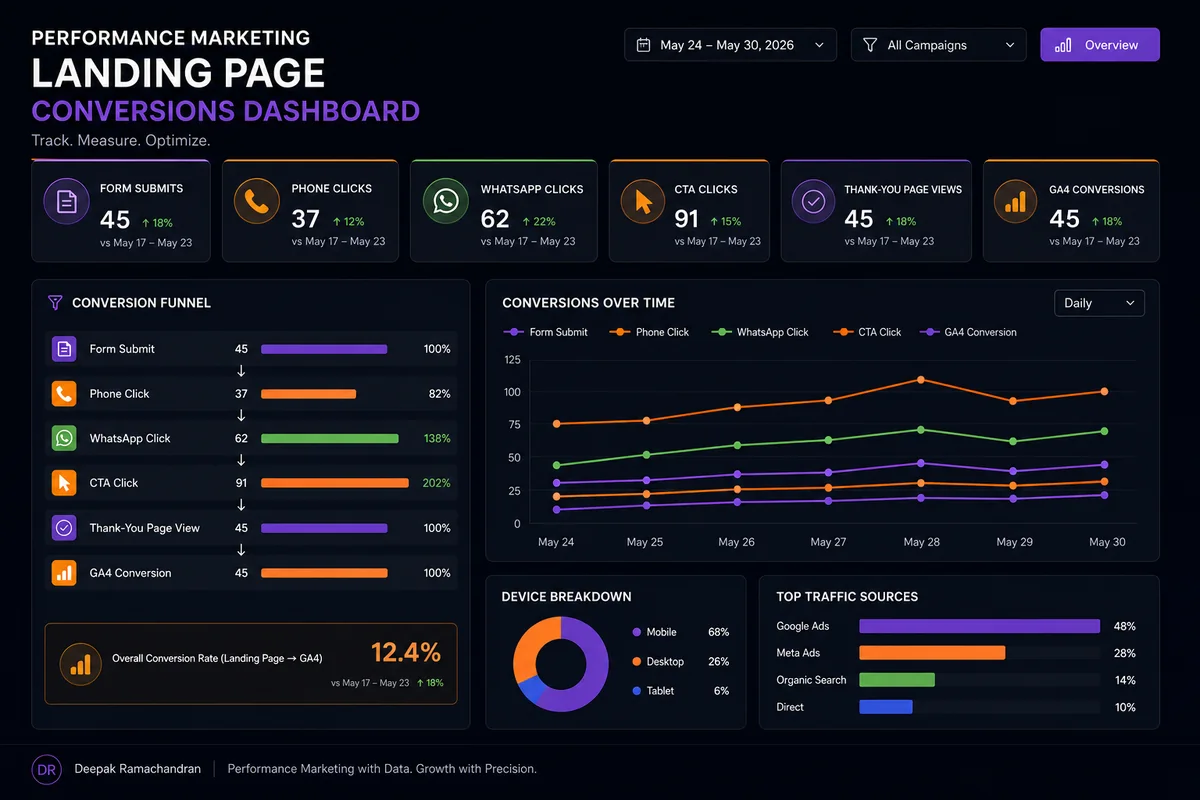
Landing page optimization is incomplete without tracking. A landing page should not only look good. It should help measure campaign performance.
Important actions to track include form submissions, phone clicks, WhatsApp clicks, button clicks, lead magnet downloads, appointment bookings, purchase events, thank-you page visits, scroll depth if useful, and key engagement events.
Tracking tools may include Google Ads conversion tracking, Google Tag Manager, GA4 events, Meta Pixel, UTM parameters, CRM or lead sheet, and call tracking where relevant.
Without tracking, campaign decisions become guesswork. A landing page may seem visually strong, but if it does not generate measurable conversions, it needs review. This is where conversion tracking basics become important for performance marketing.
10. Review campaign data and optimize
Landing page optimization should continue after the campaign starts. Useful performance signals include conversion rate, cost per lead, lead quality, bounce rate, engagement time, scroll depth, form completion rate, click-through to CTA, device performance, page speed, keyword-level conversion data, and audience-level conversion data.
The goal is not to change everything randomly. A practical optimization workflow is to check the campaign objective, review ad-to-page message match, check mobile performance, review conversion tracking, identify drop-off points, improve one major issue, run the campaign again, compare results, and repeat based on data.
Small changes can matter, but they should be based on a clear reason. GA4 reporting workflow can support this process once the tracking setup is live and reliable.
Common Landing Page Mistakes in Paid Ads Campaigns
Many paid ads campaigns fail because the landing page is not built for conversion. Common mistakes include:
- Sending paid traffic to the homepage
- Using the same landing page for every campaign
- Having a weak headline
- Not matching the ad promise
- Adding too many CTAs
- Using slow-loading images
- Ignoring mobile layout
- Making the form too long
- Not showing trust signals
- Using vague button text
- Not tracking conversions
- Adding fake urgency
- Hiding pricing when users expect it
- Using confusing service explanations
- Not explaining next steps
- Not testing page speed
- Not checking thank-you page tracking
The biggest mistake is thinking paid ads optimization happens only inside the ad platform. In reality, performance marketing includes both traffic and conversion. The landing page is where both meet.
A future landing page CRO breakdown can show this in more detail with page-level examples and conversion-path review.
Practical Example: Landing Page Flow for a Local Service Campaign
Here is a simple landing page flow for a local service business running paid ads.
Campaign example: service, interior design consultation; location, Kochi; campaign goal, lead generation; ad promise, book a free consultation for home interior planning.
Landing page flow
- Hero section: Book a free home interior consultation in Kochi, with a clear CTA to book a free consultation.
- Problem and intent match: Explain common problems like confusion about budget, material selection, space planning, and design execution.
- Service explanation: Explain what the consultation includes.
- Why choose this service: Add real trust signals such as portfolio samples, process clarity, consultation steps, and contact details.
- How it works: Submit enquiry, team contacts you, consultation is scheduled, requirements are discussed, and the next plan is shared.
- Lead form: Ask for name, phone number, location, and requirement.
- FAQ: Answer common objections about cost, timeline, location, process, and consultation details.
- Final CTA: Repeat the same CTA clearly.
This type of structure keeps the page focused on the ad intent. It does not distract users with unrelated services or unnecessary navigation. A future Google Ads campaign plan can connect this page flow with keyword intent, ad groups, bidding, and conversion tracking.
Final Landing Page Optimization Checklist
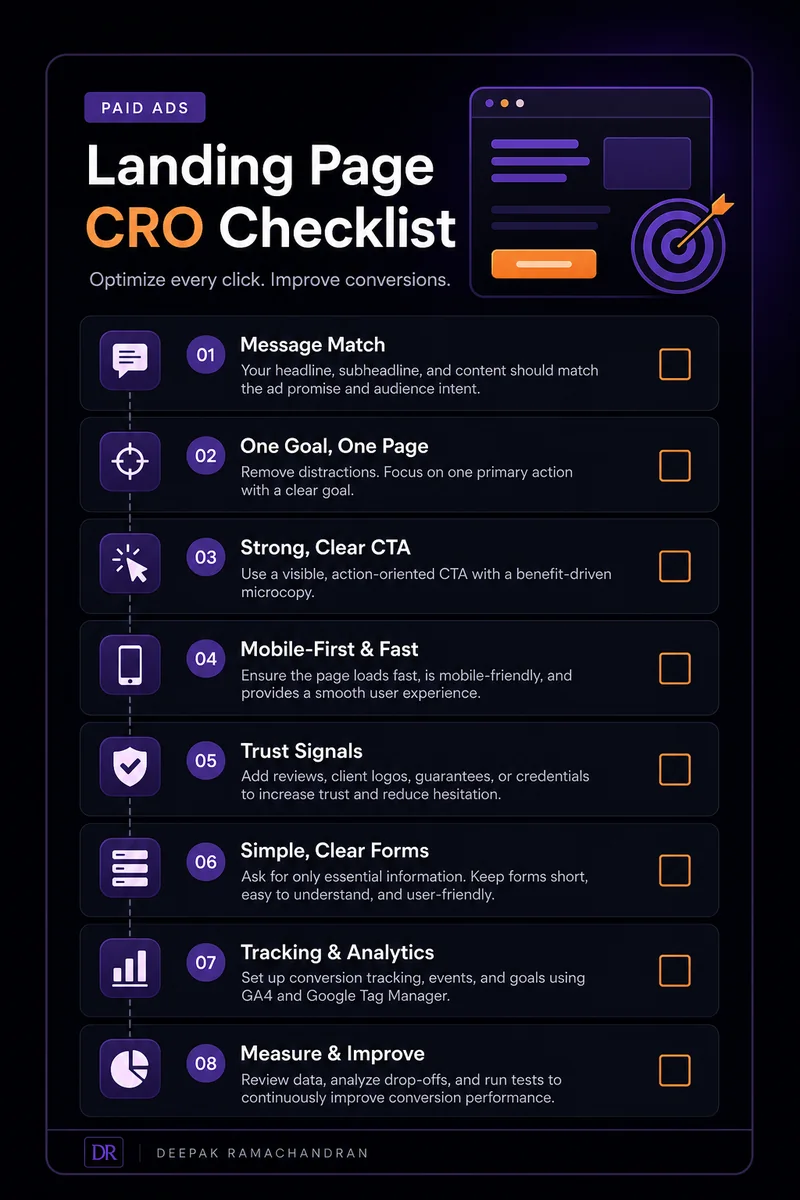
Before launching paid traffic, check:
- Ad promise matches landing page headline
- Primary CTA is clear
- Only one main conversion goal is used
- Page loads fast
- Mobile layout is clean
- Form is short and easy to complete
- Trust signals are real
- Service or offer is explained clearly
- Next steps are visible
- Images are compressed
- Tracking is active
- Thank-you page or event tracking works
- UTM parameters are added
- CTA buttons are tested
- Phone and WhatsApp links work
- Page content matches keyword or audience intent
- No fake claims are used
- No unnecessary distractions are added
- Campaign data is reviewed after launch
Landing page optimization is not about making the page look fancy. It is about making the page useful, clear, trustworthy, fast, and conversion-focused.
Local service Google Ads landing-page requirements show how campaign message, CTA clarity, service area and conversion paths should align before traffic is sent.
Conclusion
Landing Page Optimization for Paid Ads is one of the most important parts of performance marketing because it directly affects what happens after the click.
A paid campaign should not stop at traffic generation. The real work is connecting ad intent with landing page relevance, user trust, mobile experience, form clarity, and conversion tracking.
A strong landing page helps users understand the offer quickly and take action with less confusion.
For better paid ads performance, focus on clear message match, one primary goal, strong above-the-fold section, fast mobile experience, specific CTA, simple form, real trust signals, accurate tracking, and data-based optimization.
When the ad, landing page, and tracking system work together, campaign decisions become clearer and optimization becomes more practical.
FAQ Section
What is landing page optimization for paid ads?
Landing page optimization for paid ads means improving the page users visit after clicking an ad so it matches their intent, explains the offer clearly, builds trust, and encourages a specific conversion action.
Why should paid ads not always go to the homepage?
A homepage usually has multiple purposes. A paid ads landing page should focus on one campaign goal, one audience intent, and one conversion action. This makes the user journey clearer.
What is message match in landing page optimization?
Message match means the ad copy, keyword, offer, landing page headline, content, and CTA all align with the same user intent. It helps users feel that they reached the right page after clicking the ad.
What should a paid ads landing page include?
A paid ads landing page should include a clear headline, relevant offer explanation, CTA, trust signals, mobile-friendly design, fast loading speed, simple form, and conversion tracking.
How do I know if my landing page is working?
Track conversion rate, cost per lead, lead quality, form submissions, phone clicks, WhatsApp clicks, engagement time, and device-level performance. The page should be reviewed along with campaign data.
CTA Section
A paid ads campaign becomes stronger when the landing page is planned before the budget is scaled.
Explore the Performance Marketing Resource Hub for more practical guides on Google Ads, conversion tracking, landing page optimization, GA4 reporting, CRO, and campaign planning. You can also explore the main portfolio at deepakramachandran.com.