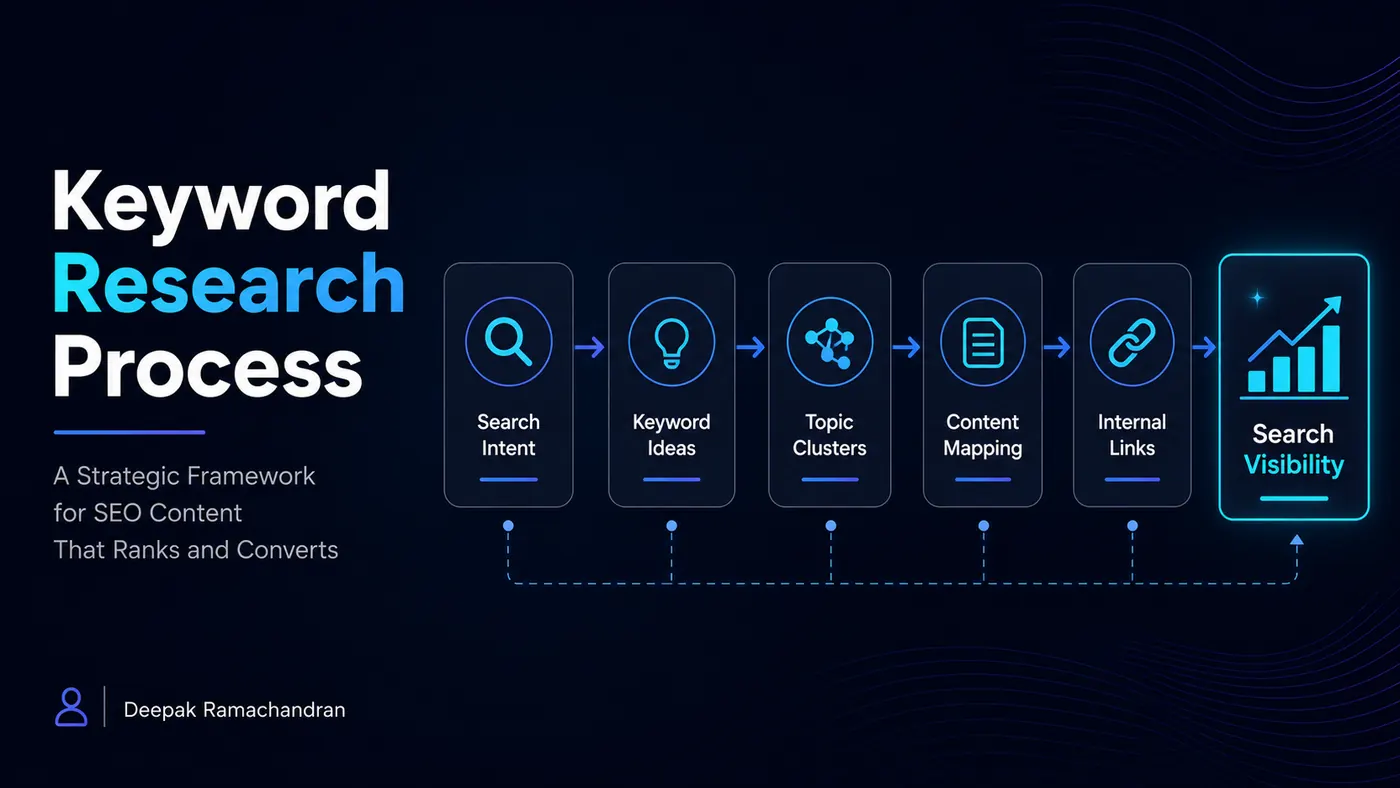
A Keyword Research Process helps identify what people search for, why they search for it, and how a website can create content that matches that intent.
SEO content should not start with random blog ideas. It should start with search behavior.
When keyword research is done properly, it becomes easier to decide which pages to create, which blogs to publish, which topics to group together, and how to build topical authority over time.
For a business website, keyword research is not only about finding high-volume keywords. It is about understanding the connection between user intent, business relevance, content structure, and search visibility.
On my website, the SEO Resource Hub is structured to connect keyword research, on-page SEO, technical SEO, internal linking, WordPress SEO, and SEO audits into one practical SEO implementation system.
What are the main steps in keyword research? The main steps in keyword research are choosing a seed topic, discovering related keywords, classifying search intent, reviewing the SERP, mapping keywords to pages, preparing content briefs and measuring performance. The goal is not to collect the biggest list, but to assign useful topics to the right website pages.
How do you identify search intent?
Search intent is identified by looking at what users likely want and what types of pages already rank for the query. If results show guides, service pages, comparisons or local listings, the content format should match that expectation.
After keyword mapping, an internal linking strategy for related SEO pages helps connect mapped pages into a stronger topic cluster.
How should keywords be mapped to website pages?
Keywords should be mapped so one main topic belongs to one primary page. Supporting keywords can strengthen that page, while separate intents should become separate service pages, guides or cluster articles.
How can keyword cannibalization be avoided?
Keyword cannibalization can be avoided by giving each page a distinct purpose, title, URL and internal-link role. When two pages target the same intent, they should be consolidated, differentiated or linked in a clear hierarchy.
- Seed Topic
- Keyword Discovery
- Intent Classification
- SERP Review
- Page Mapping
- Content Brief
- Measurement
This original visual is provided as readable HTML so users and search systems can understand the full process without relying only on an image.
Small keyword mapping example
| Keyword | Intent | Assigned Page | Funnel Stage | Cannibalization Note |
|---|---|---|---|---|
| SEO guide | Broad informational | /seo-guide/ | Awareness | Use as the main SEO pillar page |
| SEO for business websites | Business education | /seo-for-business-websites/ | Awareness | Support the SEO guide without repeating the full guide |
| on-page SEO checklist | Practical implementation | /on-page-seo-checklist/ | Implementation | Keep focused on page-level checks |
| keyword research process | Process / planning | /keyword-research-process/ | Implementation | Own keyword planning and search intent mapping |
| technical SEO for WordPress | Technical implementation | /technical-seo-for-wordpress/ | Implementation | Keep separate from on-page content checks |
| internal linking strategy | Site architecture / topical authority | /internal-linking-strategy/ | Implementation | Own hub, pillar, cluster, and reverse-link planning |
| SEO audit example | Proof / audit example | /seo-audit-example-wordpress-website/ | Proof | Use as applied portfolio evidence, not a checklist duplicate |
This example uses real site topics and no invented search-volume data.
Related reading and topical path
This article connects to its hub, guide and related supporting articles.
Written by Deepak Ramachandran
Reviewed/updated: June 16, 2026
Table of Contents
- What Is a Keyword Research Process?
- Why Keyword Research Matters for SEO Content Strategy
- How Keyword Research Works in Practice
- Keyword Research Process Step by Step
- Common Keyword Research Mistakes
- Practical Example: Keyword Research for a Service Website
- Final Keyword Research Checklist
- Conclusion
- FAQ Section
What Is a Keyword Research Process?
A Keyword Research Process is a structured method for finding, analyzing, grouping, and using keywords for SEO content planning.
It helps answer questions like:
What does the audience search for?
Which keywords are relevant to the website?
What is the intent behind each keyword?
Which keywords should become service pages?
Which keywords should become blog posts?
Which keywords should support pillar pages?
Which topics should be grouped together?
Which pages should internally link to each other?
A simple way to understand keyword research is this:
Keywords show demand.
Search intent shows meaning.
Content strategy turns both into useful pages.
For example, someone searching “SEO services in Thrissur” may be looking for a service provider. But someone searching “what is on-page SEO” is likely looking for information.
Both keywords belong to SEO, but they need different page types.
One may need a service page.
The other may need a blog post or guide.
That is why keyword research should not stop at collecting keywords. The real work is understanding how each keyword fits into the website structure.
Why Keyword Research Matters for SEO Content Strategy
Keyword research matters because SEO content without keyword direction can become disconnected from what users actually search for.
A business may publish many blogs, but if those blogs do not match real search intent, the content may not bring useful visibility.
A strong keyword research process helps with:
Finding real search topics
Understanding user intent
Avoiding random blog publishing
Planning pillar and cluster content
Reducing keyword cannibalization
Improving internal linking
Prioritizing business-relevant topics
Creating SEO-friendly page structure
Supporting long-term topical authority
For example, a website about digital marketing should not randomly publish blogs on every marketing topic at once.
It needs structure.
A better approach is:
SEO foundation topic
On-page SEO topic
Technical SEO topic
Keyword research topic
Internal linking topic
WordPress SEO topic
SEO audit example
This creates a topic cluster.
Each blog supports the larger SEO category instead of standing alone.
That is why keyword research is closely connected to the Complete SEO Guide. A keyword plan should support the bigger SEO learning and implementation structure, not just individual blog rankings.
How Keyword Research Works in Practice
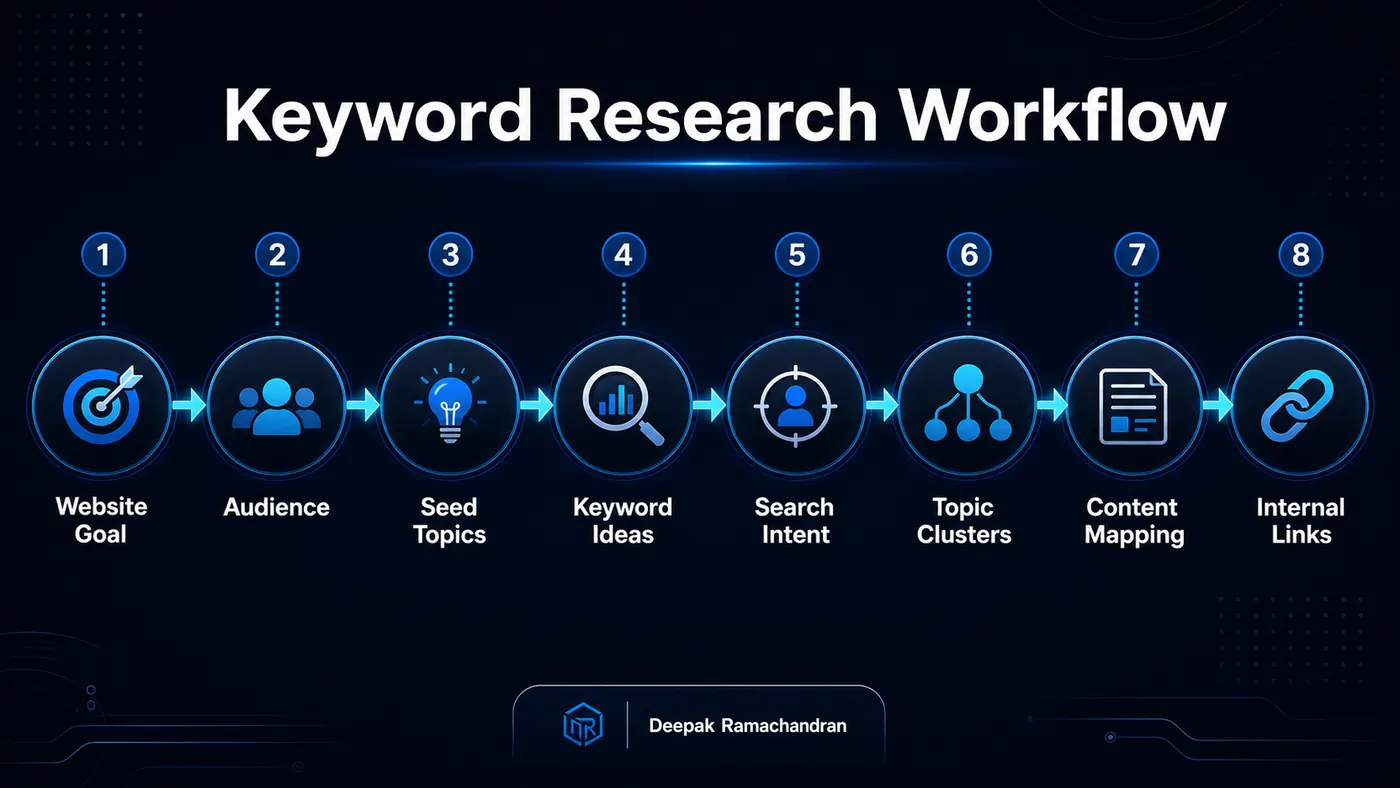
Keyword research becomes practical when it is connected to search intent, relevance, topic grouping, and content mapping.
Search intent
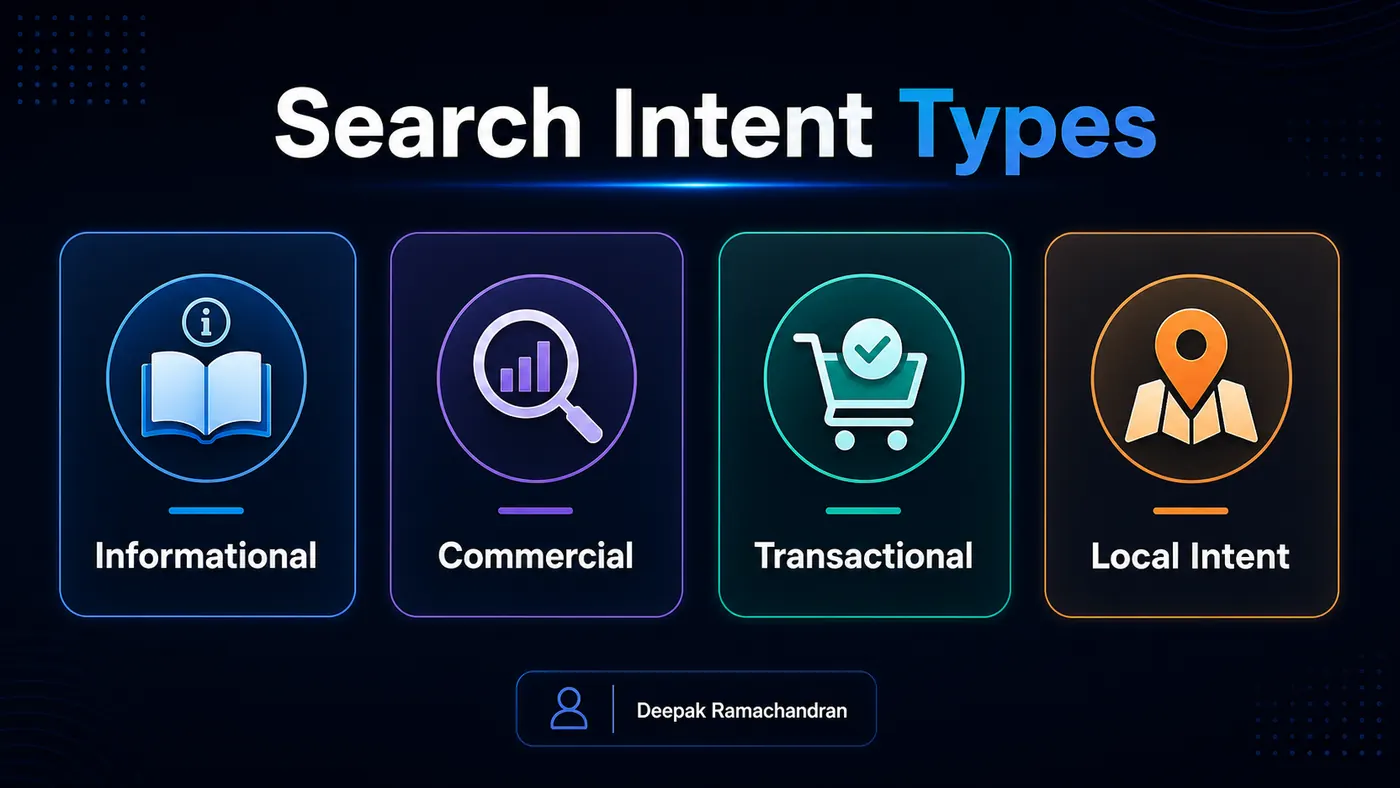
Search intent means the reason behind a search.
Most keywords fall into broad intent types:
Informational intent
Commercial investigation intent
Transactional intent
Navigational intent
Local intent
Examples:
- “What is SEO?”
Informational intent - “Best SEO tools for small business”
Commercial investigation intent - “SEO services in Thrissur”
Local or transactional intent - “Google Search Console login”
Navigational intent
The content type should match the intent.
If the user wants a guide, a sales page may not rank well.
If the user wants a service provider, a general blog may not convert well.
Search intent is one of the most important parts of keyword research.
Keyword relevance
A keyword may have search volume, but that does not mean it is useful for every website.
For a business website, keyword relevance matters more than chasing every high-volume term.
A keyword is relevant when it connects to:
The website’s services
The audience’s problems
The brand’s expertise area
The content hub
The business goal
The conversion path
The topical authority plan
For example, a website focused on SEO and performance marketing should prioritize keywords around SEO, Google Ads, analytics, CRO, content strategy, website optimization, and campaign planning.
It should not publish unrelated topics just because they have search volume.
Topic grouping
Topic grouping means organizing related keywords into clusters.
Instead of treating every keyword as a separate blog idea, related keywords should be grouped under one main topic.
Example:
Main topic: On-page SEO checklist
Related keywords:
On-page SEO checklist
On-page SEO factors
SEO title tag optimization
Meta description SEO
H1 tag SEO
Internal links SEO
Image alt text SEO
SEO content optimization
These keywords can support one strong blog instead of multiple thin blogs.
Topic grouping helps prevent keyword cannibalization.
Keyword cannibalization happens when multiple pages on the same website compete for the same or very similar keyword intent.
Content mapping
Content mapping means deciding which keyword belongs to which page.
Not every keyword should become a blog.
Some keywords are better for:
Homepage
Service page
Hub page
Pillar page
Cluster blog
FAQ section
Case study
Comparison post
Checklist post
Local landing page
Example:
- “Digital Marketer in Thrissur”
Homepage or local service positioning page - “SEO for business websites”
Foundation blog - “On-page SEO checklist”
Cluster blog - “SEO guide”
Pillar page - “SEO audit example”
Proof blog
This mapping keeps the website organized.
Keyword Research Process Step by Step
Use this process before creating SEO blogs or website pages.
1. Understand the website goal
Keyword research should begin with the website’s goal.
A website may want to:
Generate leads
Build topical authority
Rank for local service keywords
Support portfolio positioning
Educate users
Build recruiter trust
Sell products
Improve brand visibility
Support paid campaigns
Create long-term organic traffic
For a business website, keyword research should not only focus on traffic. It should focus on useful traffic.
Ask:
What does the website want to be known for?
Which services or skills matter most?
Which topics support the business?
Which audience should find the website?
Which keywords can lead to action later?
If the website goal is unclear, keyword research becomes scattered.
2. Define the target audience
The same topic can have different keyword angles depending on the audience.
For example, “keyword research” can be searched by:
Business owners
SEO beginners
Marketing students
Content writers
Agency teams
Recruiters
Local business owners
E-commerce teams
Each audience needs a different explanation.
A business owner may want practical content planning.
A content writer may want blog topic ideas.
An SEO professional may want advanced clustering.
A recruiter may look for practical implementation understanding.
Before choosing keywords, define who the content is for.
Ask:
Who is searching?
What problem are they trying to solve?
How much do they already know?
What action should they take after reading?
What type of content would help them most?
This helps shape the content angle.
3. List seed topics
Seed topics are broad topics related to the website.
For an SEO-focused website, seed topics may include:
SEO
On-page SEO
Technical SEO
Keyword research
Internal linking
WordPress SEO
SEO audits
Content strategy
Google Search Console
Local SEO
Topical authority
For a performance marketing website, seed topics may include:
Google Ads
Meta Ads
Conversion tracking
Landing pages
CRO
GA4 reporting
Campaign structure
Budget planning
Lead generation
Seed topics help start the keyword research process.
They are not final keywords. They are topic areas that can later be expanded into specific search queries.
4. Find keyword ideas
After seed topics are ready, find keyword ideas.
Keyword ideas can come from:
Google autocomplete
People Also Ask
Related searches
Google Search Console
SEO tools
Competitor pages
Forum questions
YouTube search suggestions
Customer questions
Sales call questions
Blog comments
Social media questions
Internal site search, if available
Example seed topic:
Technical SEO
Keyword ideas:
Technical SEO for WordPress
Technical SEO checklist
Technical SEO basics
WordPress technical SEO
Technical SEO audit
Technical SEO for business websites
Technical SEO issues
Technical SEO tools
At this stage, collect ideas widely. Filtering happens later.
5. Understand search intent
After collecting keyword ideas, check the intent behind each keyword.
Do not assume intent only from the phrase.
Search the keyword and review the type of pages ranking.
Look at:
Are ranking pages blogs?
Are they service pages?
Are they product pages?
Are they guides?
Are they list posts?
Are they local pages?
Are they tool pages?
Are they comparison pages?
For example:
“SEO checklist” may show blog/checklist results.
“SEO agency near me” may show local service results.
“Google Search Console” may show tool/navigation results.
The SERP shows what Google believes users want.
A content plan should respect that. The Google Search Central SEO Starter Guide provides additional guidance on helping search engines understand useful website content.
6. Group keywords into topic clusters
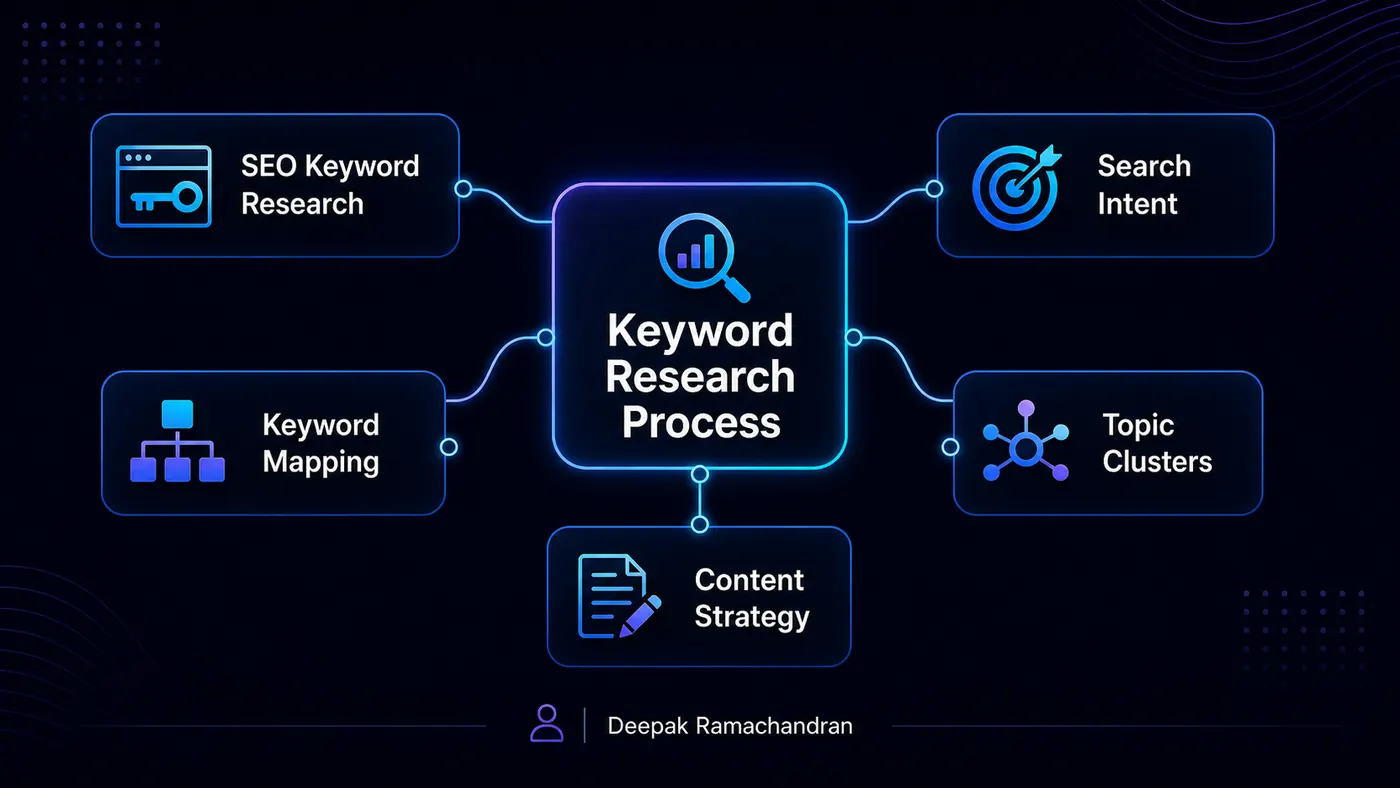
After identifying intent, group related keywords together.
Example cluster:
Primary topic: Keyword Research Process
Supporting keywords:
SEO keyword research
Keyword research strategy
Keyword research for SEO
Search intent SEO
Keyword mapping
Content keyword research
Keyword research checklist
Topic clusters SEO
This cluster can become one complete blog.
Another cluster:
Primary topic: Internal Linking Strategy
Supporting keywords:
Internal linking SEO
Internal links for topical authority
Anchor text SEO
Hub pillar cluster linking
Internal link structure
SEO silo structure
This becomes a separate blog.
Grouping prevents thin content and duplicate intent.
7. Choose primary and secondary keywords
Every important blog or page should have one primary keyword.
The primary keyword should be the main search phrase the page targets.
Secondary keywords support the main topic.
Example for this blog:
Primary keyword:
Keyword Research Process
Secondary keywords:
SEO keyword research
Keyword research strategy
Keyword research for SEO
Keyword mapping
SEO content strategy
The primary keyword should appear naturally in:
SEO title
H1
First paragraph or early content
Meta description
Slug
Some headings, where natural
Image alt text, at least once if relevant
But it should not be repeated unnaturally.
Keyword density should not damage readability.
8. Analyze the SERP before writing
SERP analysis means reviewing the search results page before creating content.
This helps understand what kind of content is expected.
Check:
Top ranking page types
Common headings
Content depth
Search intent
FAQ patterns
Media usage
Examples used
Tools mentioned
Content gaps
Angle opportunities
The goal is not to copy competitors.
The goal is to understand the search landscape and create a better, more useful structure.
A strong SEO blog should have original explanation, practical workflow, examples, checklists, and internal links.
9. Map keywords to pages and blogs
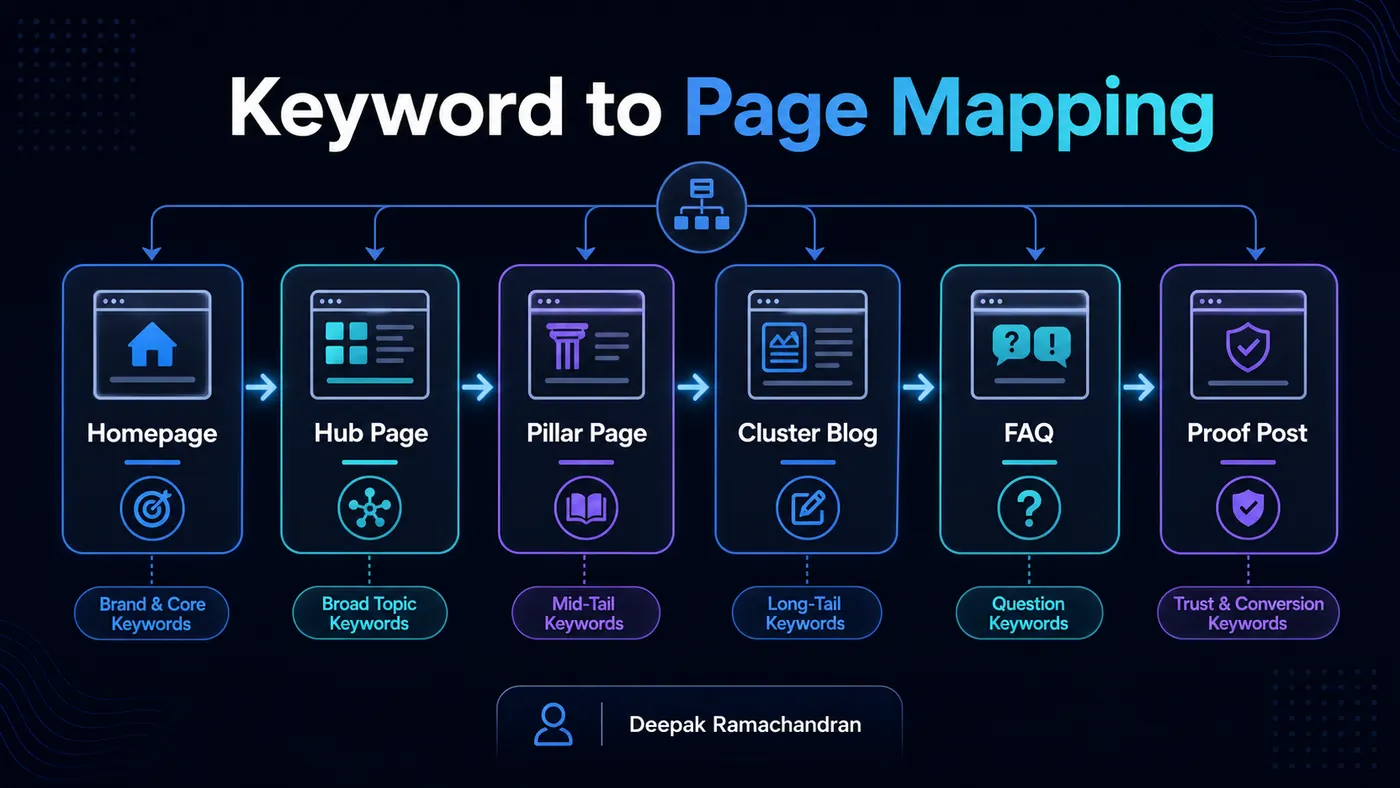
Once keywords are grouped, map them to content types.
Example:
Homepage:
Digital Marketer in Thrissur
Hub page:
SEO Resource Hub
Pillar page:
SEO Guide
Cluster blogs:
SEO for Business Websites
On-Page SEO Checklist
Keyword Research Process
Technical SEO for WordPress
Internal Linking Strategy
WordPress SEO Optimization Checklist
Proof blogs:
SEO Audit Example
RankMath SEO Setup Checklist
Google Search Console Insights
This mapping gives the website structure.
It also helps avoid publishing random blogs that do not support the main SEO direction.
10. Plan internal links around topics
Keyword research should lead to internal linking.
If pages are related, they should connect naturally.
Example internal link flow:
SEO Resource Hub links to SEO Guide
SEO Guide links to keyword research blog
Keyword research blog links to on-page SEO blog
On-page SEO blog links to internal linking blog
Technical SEO blog links to SEO audit example
SEO audit example links back to the SEO Resource Hub
This helps users move through related content.
It also helps search engines understand topic relationships.
Internal links should use descriptive anchor text.
Avoid weak anchor text like:
Click here
Read more
Learn more
This article
Better anchor text examples:
keyword research process
on-page SEO checklist
technical SEO for WordPress
internal linking strategy
SEO audit example
Internal linking should feel natural, not forced.
Common Keyword Research Mistakes
Many SEO content problems begin with weak keyword research.
Common mistakes include:
Choosing keywords only because they have high volume
Ignoring search intent
Writing blogs without keyword mapping
Targeting the same keyword on multiple pages
Using one blog for too many unrelated topics
Creating separate blogs for very similar keywords
Ignoring business relevance
Copying competitor structure blindly
Not checking the SERP
Not planning internal links
Using keywords unnaturally
Forgetting long-tail keywords
Ignoring local intent
Not updating old keyword plans
Publishing blogs without a hub structure
The biggest mistake is treating keyword research as a list of words.
Keyword research should become a content strategy.
It should guide what to publish, how to structure it, and how pages connect to each other.
Practical Example: Keyword Research for a Service Website
Here is a simple example for a local service website.
Business type:
Dental clinic in Kochi
Main business goal:
Generate appointment enquiries
Seed topics:
Dental clinic
Teeth cleaning
Root canal
Dental implants
Teeth whitening
Braces
Emergency dental care
Smile correction
Keyword ideas:
Dental clinic in Kochi
Best dentist in Kochi
Teeth cleaning cost in Kochi
Root canal treatment Kochi
Dental implants Kochi
Teeth whitening Kochi
Braces for adults Kochi
Emergency dentist Kochi
How often should teeth cleaning be done
Is root canal painful
Dental implant procedure steps
Now map intent.
Service page keywords:
Dental clinic in Kochi
Root canal treatment Kochi
Dental implants Kochi
Teeth whitening Kochi
Emergency dentist Kochi
Blog keywords:
How often should teeth cleaning be done
Is root canal painful
Dental implant procedure steps
Teeth whitening aftercare
Braces for adults guide
Pillar or guide content:
Complete dental care guide
Dental treatment options in Kochi
FAQ sections:
Treatment cost
Appointment process
Pain concerns
Recovery time
Insurance or payment options
Clinic location
Emergency availability
This structure helps the website serve both search intent and business goals.
The service pages target high-intent users.
The blogs educate users and support topical authority.
The FAQ sections answer objections.
Internal links connect educational content to service pages.
This is how keyword research becomes practical SEO planning.
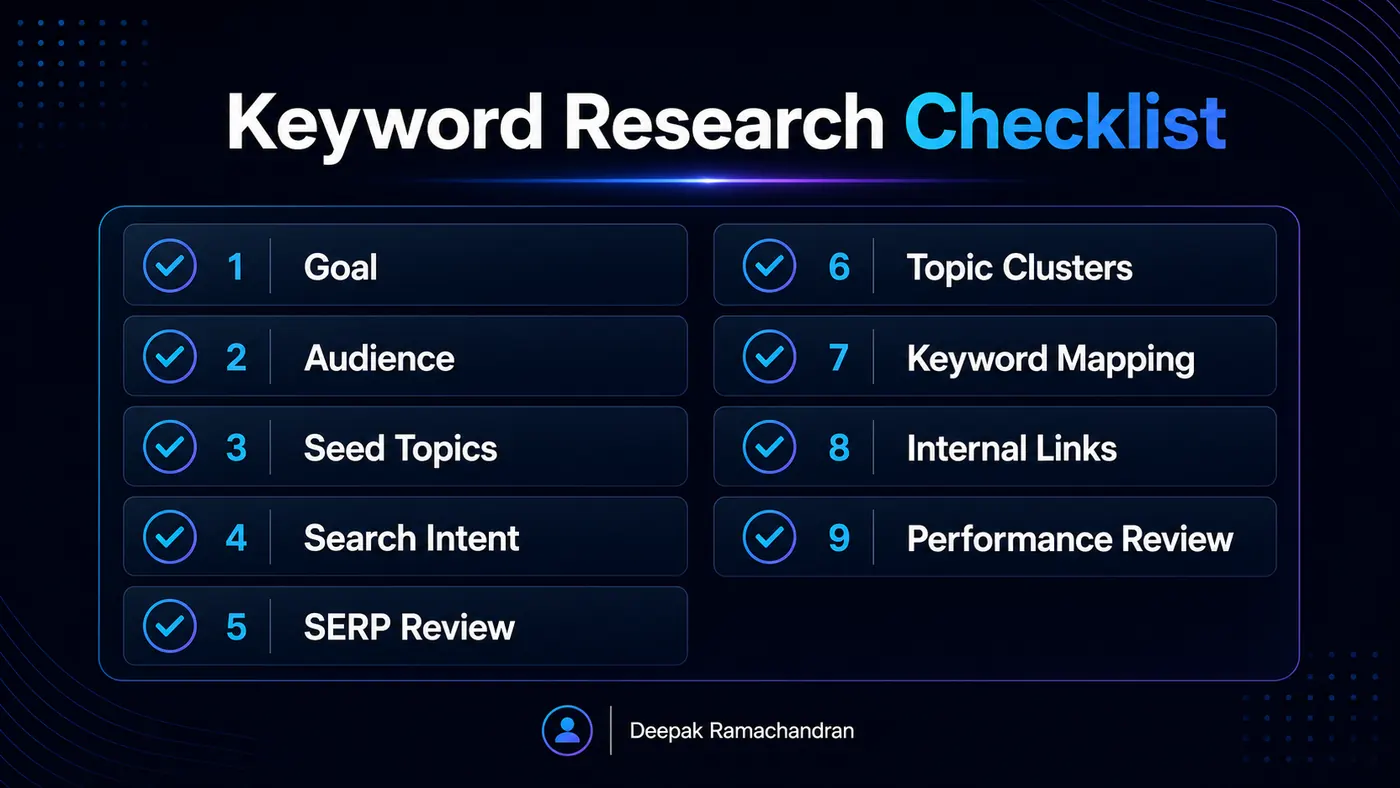
Final Keyword Research Checklist
Before finalizing a keyword plan, check:
Website goal is clear
Target audience is defined
Seed topics are listed
Keyword ideas are collected
Search intent is reviewed
SERP type is analyzed
Keywords are grouped into clusters
One primary keyword is chosen per page
Secondary keywords support the main topic
Duplicate intent is avoided
Business relevance is checked
Content type is selected
Keyword is mapped to the right URL
Internal links are planned
Hub and pillar structure is considered
Long-tail keywords are included
Local intent is separated where needed
Keyword stuffing is avoided
Content gaps are identified
Publishing priority is decided
A Keyword Research Process should make content planning clearer, not more complicated.
Conclusion
A Keyword Research Process is one of the most important parts of SEO content strategy because it connects search behavior with website structure.
Strong keyword research helps decide what content to create, which keywords to target, how to group topics, which pages should exist, and how internal links should support topical authority.
For business websites, keyword research should not be treated as a one-time list.
It should become part of the SEO workflow:
Understand the website goal.
Define the audience.
Collect keyword ideas.
Analyze search intent.
Group related topics.
Map keywords to pages.
Plan internal links.
Publish content with purpose.
Review performance over time.
When keyword research is done this way, SEO content becomes more structured, more useful, and more aligned with long-term search visibility.
Related SEO Guides
FAQ Section
What is a Keyword Research Process?
A Keyword Research Process is a structured method for finding, analyzing, grouping, and mapping keywords so they can be used for SEO content planning and website structure.
Why is keyword research important for SEO?
Keyword research helps identify what users search for, what intent they have, and what type of content should be created to match that intent. It prevents random content publishing.
What is the difference between primary and secondary keywords?
A primary keyword is the main keyword a page targets. Secondary keywords support the same topic and help cover related search phrases naturally inside the content.
How do I avoid keyword cannibalization?
Avoid targeting the same keyword or same search intent across multiple pages. Group similar keywords into one strong page and map each main keyword to a specific URL.
Should every keyword become a blog post?
No. Some keywords are better for service pages, hub pages, pillar pages, FAQs, comparison posts, or local landing pages. Keyword intent should decide the content type.
CTA Section
If SEO content feels random, the problem may not be writing. It may be the lack of a proper keyword research and content mapping system.
Explore the SEO Resource Hub for more practical SEO guides on keyword research, on-page SEO, technical SEO, internal linking, WordPress SEO, and topical authority.
Visit deepakramachandran.com to explore the wider SEO and performance marketing portfolio.
An SEO audit example for search intent review helps connect keyword planning with page purpose, content structure and prioritization.